Radio Salone

Travel Through Music

Post Top Ad

junio 10, 2022

Bombino - Deran - Niger - 2018


How to celebrate the desert at home, how to protect it, develop it, unify it, respect it and, above all, never forget it, are the main themes of Bombino's new album 'Deran'. They are dressed in ten songs of rare maturity and power that mark a turning point in the career of a guitarist and composer who was born in the shade of an acacia tree some fifty miles northwest of the ancient city of Agadez, and who has since promoted to the new guitar Tuareg Generation. It's a throwback to the source of everything that makes Bombino who he is.


"My mission for this album was always to get closer to Africa," he says. It is no surprise then that the decision has been made to record 'Deran' as close as possible to his native Niger in the south of the Sahara. The ideal location arose in the form of Studio Hiba, a high-flying recording facility owned by King Mohammed VI located in an industrial suburb of Casablanca in Morocco. There, Bombino and his long-term stable band - including Tuareg Illias Mohammed on guitar and vocals, American Corey Wilhelm on drums and percussion, and Mauritanian (who lives in Belgium) Youba Dia on bass - slept, ate and music in happy isolation. His circle was widened by Moroccan percussionist Hassan Krifa, and by Bombino's cousins ​​Anana ag Haroun (vocalist of the Brussels-based Tuareg band Kel Assouf) and Toulou Kiki (singer and star of the film Timbuktu), who came to add some 'gang' voices. After Casablanca, the tapes were flown to Boston to be embellished by friend and Sudanese keyboardist Mohammed Araki.


Bombino and the crew conjured up an itinerant journey through the mystery of contemporary Saharawi sounds, from the raw diesel rock of opener 'Imajghane' ('The Tuareg'), to the camel gait of 'Tenesse' ('Idleness'), the tender cadence of Midiwan ('My Friends') and the 'Tuareggae' style which is Bombino's only contribution to desert music in the song 'Tehigren'. The whole desert is there, hard and gentle, tragic and playful. But more than anything 'Deran' is honest and true. Deran, Deran, Alkheir. "My best wishes, my best wishes, for peace."


TRACKLIST

1. Imajghane

2. Deran Deran Alkheir

3. Tehigren

4. Mikiwan

5. Tenesse

6. Ouhlin

7. Adouni Dagh

8. Tamasheq

9. Takamba

10. Adouagh Chegren


mayo 28, 2022

Youssou N´Dour - Dakar-Kingston - 2010


Youssou N´Dour, one of the most well-known Senegalese singers and composers worldwide, surprises us in 2010 with Dakar-Kingston. A self-confessed admirer of Bob Marley, he has recorded revisions of old and recent songs to the rhythm of reggae, resulting in surprising work if we take into account that Youssou is the master of mbalax music. In fact, the emblematic rhythm of the island of Jamaica has a similar origin to the Senegalese mbalax, if we take into account the rhythms carried by the African population forced to travel.


Produced by Marley's old friend and Wailers member Tyrone Downie, Youssou N'Dour is surrounded by the best: Earl "China" Smith on guitar, Patrice Bart-Williams and singer Ayo, legendary reggae band Morgan Heritage. , and Yusuf Islam (Cat Stevens) composing the first theme titled "Marley".


Tracks list:

01. Marley (feat Mutabaruka)

02. Medina

03. Joker (feat Patrice)

04. Bololene

05. Bamba

06. Black Woman

07. Survie

08. Africa Dream Again (feat Ayo)

09. Diarr Diarr

10. Don’t Walk Away (feat Morgan Heritage)

11. Bagn Len

12. Leteuma

13. Pitch Me


mayo 21, 2022

World Music Network - The Rough Guide to Marrabenta Mozambique - 2001


01. Dilon Djindji - Maria Teresa

02. Ochestra Marrabenta s star de - Matilde

03. Mabulu - Mahanhela 

04.Ghorwane - U yo mussiva kwini

05. Eyuphuro - Othiawene

06. Alberto Mula - Anghena bava mula

07. Francisco Mahecuane - Rosa

08. Mario Ntimane - Tchela Kuwomile

09. Wazimbo - Xigevengu

10. Antonio Marcos - Shywelele

11. Arakas Band - Sumbhulany

12. Nene - Africa

13. Gito Baloi - Marrabenta

14. Orchestra star de mozambiquke - Elisa Gomara Saia 

15. Lisboa Matavel - Hlamalane

mayo 17, 2022

Temenik Electric - Ouesh Hada? - 2013


From the vibrant multicultural melting pot of Marseille comes Temenik Electric's debut album, Ouesh Hada? (2013), an exquisite excursion through Arab rock that extends to both sides of the Mediterranean. The jagged electric guitars and rock rhythms of songs like "Hel El Bab" and "Arteni Boussa" ring with the energy of Led Zeppelin or U2, evoking the spirit of agitation of Rachid Taha or Cheikha Rimitti. But the infectious pop melodies and electro-rock beats are just one element of a splendid hybridity that also picks up traditional gnawa, chaabi, raï rhythms and influences from all over the Maghreb with hypnotically played ouds and other instrumentation.


Temenik Electric's Arab rock is not a copy of the Anglo-American formats. The rock of Temenik Electric, fronted by singer-songwriter Mehdi Haddjeri, comes from a very different place, crafting a sound that is essentially rooted in the spirit of North Africa but takes the language of Western rock music and dynamically absorbs the continuous lineage of Arab musical culture. It's "fusion" at its best and, like Tinariwen, a thrilling example of artists' ability to embrace western rock guitar and still sound wildly original, robust and unadulterated.


Staff:


Mehdi Haddjeri (voz, guitarra, coros)

Jerôme Bernaudon (bajo, coros)

Hassan Tighidet (guitarra)

Djamel Taouacht (batería, percusión, coros)

Mathieu Hours (programación)


01. Li Fèt Mèt (part 1)

02. Ness Jirènin

03. Dèouni

04. Hel El Bab

05. Arteni Boussa

06. Faïn Kount

07. Ouesh Hada

08. Rikha

09. Haïnik

10. Li Fèt Mèt (part 2)

11. Chibani


abril 25, 2022

Introduccion a la Musica Popular Cubana - 2000


Collection made by Virgin Spain (2000) in two volumes, in which the genres, the best performers and the emblematic songs of Cuban music of the 20th century are shown.


Tracks list:


Vol. I

01. Familia Valera-Miranda - Nengón para tí

02. Grupo Santiago de Cuba - Punto y zapateo

03. Orquesta Típica Odilio Urfé - San Pascual Bailón

04. Charanga Típica de Conciertos - La Revoltosa

05. Barbarito Díez con Orq. Antonio Mª Romeu - La Mora

06. Órgano de Manzanillo - Son de Manzanillo

07. Grupo Changüi de Guantánamo - María Guevara

08. Tumba Ntra. Sra. de la Caridad - Tumba francesa

09. Merceditas Valdés - Toque y rezo Lucumí

10. José Oriol Y Grupo Folklóriko - Toque Congo

11. Orq. Típica de Santiago de Cuba - Carabalí Isuama

12. Coro Folklórico - Marcha Abakuá

13. Comparsa El Alacrán - Tumbando caña

14. Orquesta Folklórica - Rompiendo la rutina

15. Orquesta Gonzalo Roig - Quiéreme mucho

16. Trío Matamoros - Mariposita de primavera

17. Dúo Cubano - María Cristina

18. Septeto Nacional - Lejana campiña

19. Conjunto de Arsenio Rodríguez - Mamí me gustó


Vol. II

01. Los Guaracheros de Oriente - Pregón de los chicharrones

02. Dúo Hermanas Martí - Longina

03. Rita Montaner - El golpe de Bibijagua

04. Esther Borja - Estudiantina

05. Joseíto Fernández - Canta el piano

06. Orquesta América - La engañadora

07. Orquesta Anacaona - Mambo mambí

08. Carlos Embale y Grupo Folklórico - La última rumba

09. Bola de Nieve - Chivo que rompe Tambo

10. Radeunda Lima - Mi tierra es así

11. Orquesta Aragón - Caserita Villareña

12. Muñequitos de Matanzas - Los Muñequitos

13. Parranda Espirituana - Tonada palmarito

14. Elena Burke - Canción de un festival

15. Comparsa Santiaguera - Orille oriental

16. Roberto Sánchez y la Gloria Matancera - Dos Gardenias

17. Benny Moré y su Banda Gigante - Qué bueno baila usted

18. Grupo Raison - Sucu suqueando

19. Pedro Luis Ferrer - Como me gusta hablar español


abril 25, 2022

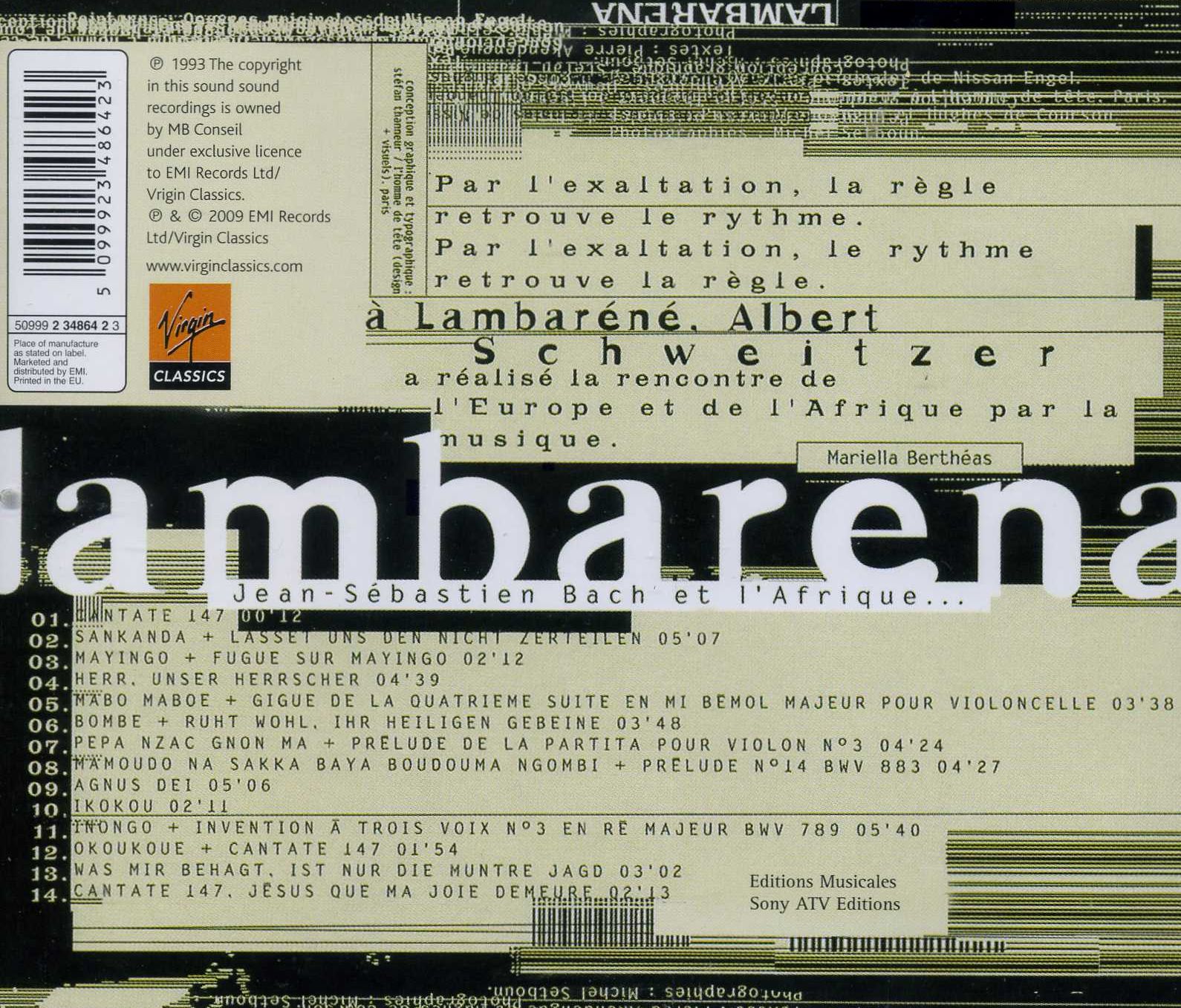
Hugues De Courson - Lambarena, Bach to Africa - 1995


The impulse behind this album, developed by Mariella Berthéas, was to create a tribute to Albert Schweitzer by bringing together the two musical traditions that are central to his life: the works of JS Bach and the musics of Gabon, where he dedicated his life to serving as a medical missionary in the city of Lambaréné. To call this a crossover album, however, would be to misrepresent it; this is not an intelligent synthesis of two disparate traditions. It is difficult to characterize the relationship between the two musical cultures. To say that the musics are "coordinated" falls short of the surprising spontaneity of the juxtapositions, but to say that they are "thrown together" suggests a randomness that underestimates the skill and artistry of the arrangers, Hughes de Courson and Pierre Akendengué. Bach's music and the musical traditions of Gabon co-exist without giving up their own integrity, and interact with varying degrees of obvious connection. The CD includes classically trained European musicians, 10 ensembles from Gabon, and several Argentine musicians, who worked together in the studio for many months to create the album. The most successful songs uncannily capture the underlying musical impulse common to the two traditions, and the result opens up new meanings, and sounds natural and organic. For example, it's amazing, on track 2, how well a traditional Gabonese song fits and overlaps with "Lasset uns nicht den Zerteilen," from the St. John Passion, and how they complement each other in their affirmation exuberant of life. On track 6, the simultaneous performance of a ritual that includes a pattern of clapping and ululating vocalizations and a chorus of the Passion according to Saint John is impressive. Not all efforts are equally successful; the chant at the end of the Agnus Dei of the Mass in B minor simply sounds tacked on. But when the mix works, as it normally does, the effect is revealing and transformative. The sound is intensely clean and very well differentiated, highlighting the wonderful strangeness of the mixture of traditions.

1 Cantate 147 0:13

2 Sankanda (traditionnel arr. P Akendengué) 5:70

3 Mayingo (traditionnel arr. P. Akendengue): Fugue sur Mayingo (T. Gubitsch) 2:12

4 Herr, Unser Herrscher 4:36

5 Mabo Maboe (traditionnel arr. P. Akendengué): Gigue de la Quatrième Suite en mi bémol majeur pour violoncelle 3:38

6 Bombé/Ruht Wohl Ihr Heiligen Gebeine 3:46

7 Pepa Nzac Gnon Ma (traditionnel arr. P. Akendengué): Prélude de la Partitia pour violon no3 4:23

8 Mamoudo Na Sakka Baya Boudouma Ngombi (traditionnel arr. P. Akendengué): Prélude No.14 BWV 883 4:28

9 Agnus Dei (Messe en si BWV 232 — arr. P. Akendengué) 5:60

10 Ikokou (traditionnel arr. P. Akendengué) 2:11

11 Inongo (traditionnel arr. P. Akendengué et H. de Courson): Invention à trois voix No3 en ré majeur BWV 789 5:40

12 Okoukoué (traditionnel arr. P. Akendengué et H. de Courson): Cantate 147 1:54

13 Was Mir Behagt, Ist Nur Die Muntre Jagd (Chorus "La Chasse" — J.S.Bach arr. P. Akendengué et H. de Courson) 3:30

14 Cantate 147 "Jesus que ma joie demeure" (J.S.Bach arr. P. Akendengué et H. Courson) 2:14


abril 23, 2022

Fatoumata Diawara - LIVE - 2012 - Mali


Born in the Ivory Coast to Malian parents, Diawara moved to France to pursue acting, appearing in Cheick Oumar Sissoko's 1999 feature film La Genèse, Dani Kouyaté's popular 2001 film Sia, le rêve du python, in the internationally renowned street theatre troupe Royal Deluxe, and played a leading role in the musical Kirikou et Karaba. 

She later took up the guitar and began composing her own material, writing songs that blend Wassalou traditions of Southern Mali with international influences. Noted for her distinct "sensuous voice," she has performed and recorded with Oumou Sangaré, AfroCubism, Dee Dee Bridgewater (on Red Earth: A Malian Journey), and the Orchestre Poly-Rythmo de Cotonou. 

Her new EP was released May 9, 2011 and her debut album Fatou with World Circuit Records was released in September 2011. 

I saw her concert live yesterday.  


abril 15, 2022

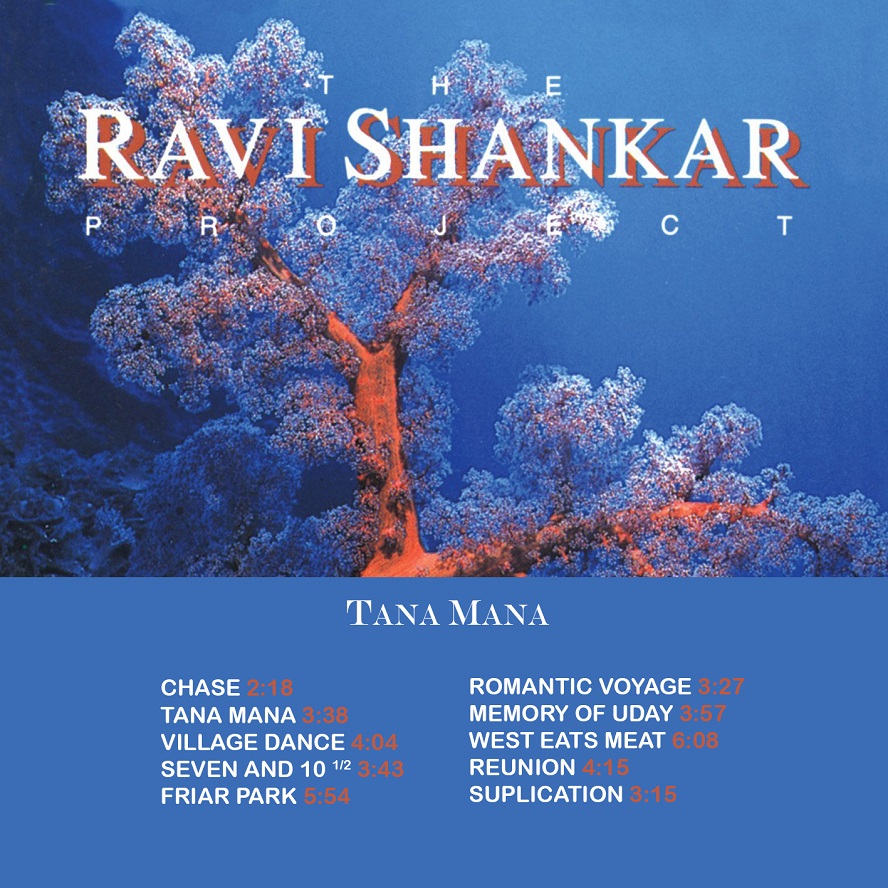
Ravi Shankar - Tana Mana - 1987


Published by Private Music in 1987, Tana Mana (which means "body and mind") is the work of Ravi Shankar that gave rise to the popularization of the term "World Music", since his proposal focuses on the fusion of Eastern and Western elements. tackling a new path in which Indian, jazz and electronic music are unified.


Precisely the term "World Music" has been, since then, paradoxical for understanding, or is it that not all music is of the world? The name was adopted in 1987 in an attempt to find a term that would reflect the globalizing spirit of the 1980s. The desire of the record companies to sell sided with certain musicians from the Southern Hemisphere and from the East who, based on their native folklore, not only explored audacious fusions with the West, but also sometimes achieved considerable success, maintaining the category of myths or teachers that they enjoyed in their respective countries. Youssou N'Dour, Ali Farka Touré, Ladysmith Black Mambazo or Nusrat Fateh Ali Khan are just some of the undeniably successful names. Peter Gabriel, Paul Simon or David Byrne are Western musicians who helped promote this label and certain artists of great interest, but for other illustrious artists such as Philip Glass there is no doubt that the Indian sitarist Ravi Shankar was key -even father- of that movement , years before its institution.

After decades of work and popularity in India and numerous trips around the world, Ravi Shankar met the Beatle George Harrison in 1966 and became his teacher (Harrison himself is a claim in Tana Mana, when he answered the call of his mentor and friend to play on the same zither and synthesizer). To make the leap to the general public, Ravi chose to make things easier, merging with other styles and instruments and shortening the duration of the songs, more in line with Western taste and radio broadcasting. Even so, despite not playing the music that the purists of his country demanded of him, this maestro achieved his goal of "not losing the Indianness of his music." Furthermore, with adaptations like this one, not without soul, Ravi took an important step to keep Indian classical music alive in the contemporary world, paving the way for other notable musicians, such as his own daughter Anoushka Shankar.

Shankar had great popularity in the US when the Beatles "discovered" him to the West, he settled in the United States and gave populous concerts, and was re-released for the general public thanks to the good eye of producer Peter Baumann for Private Music, where he published three records at the end of the 1980s, just when the aforementioned "World Music" label was beginning to be established: Tana Mana (1987), a wonderful concert in Moscow called Inside the Kremlin (1988), and the splendid and essential collaboration with Philip Glass Passages ( 1990).

In Tana Mana, Indian instrumentalists (including the vocalist Lakshmi Shankar or Shubho Shankar - son of the master, who died in 1992) merge with American names such as those of the producers (Peter Baumann and Frank Serafine) or those of Patrick O'Hearn ( on bass), Ray Cooper (Marimba), Al Cooper (guitar) or the aforementioned George Harrison. Tana Mana, composed by Ravi Shankar a year after suffering a heart attack, is a beautiful succession of singing pieces that go beyond continents and eras to abide by the universality of Indian music and make it known to the rest of the world, in its more affordable facet, through one of its great supporters. (Source: Winter Solstice)


Tracks list:

01. Chase

02. Tana Mana

03. Village Dance

04. Seven and 10½

05. Friar Park

06. Romantic Voyage

07. Memory of Uday

08. West Eats Meat

09. Reunión

10. Supplication


abril 13, 2022

Imam Baildi - Imam Baildi - 2007


Imam Baildi is a popular dish in Greek cuisine: eggplant stuffed with onions, garlic and tomatoes, cooked over low heat in olive oil. It is a very good mix, similar to the one that the brothers Lysandros and Orestis Falireas together with their band do musically. A bit of electro, a dash of hip hop and mambo, big band orchestration, and a good base of Greek sounds make Iman Baildi a perfect dish. Their sound is a perfect and unique urban mix based on the Greek tradition of bands from the forties and fifties. There is nothing like it in Greek music and it is not a homemade dish, since more than eight people participate in this band. They have released two albums since 2007, having great success in their country, Greece. They have also been in the top ten of the European "world music" lists on numerous occasions. The band is working on their next album that will be released in 2013. Iman Baildi is a dish that, without a doubt, you have to try.


In November 2010 Imam Baildi's new album “Imam Baildi Cookbook” was released. Its sounds remind us of a Greek orchestra from the 1950s revisited and interpreted through current and modern instruments. The touch of ancient Greek melodies and Balkan music serve as the basis for a rhythmic sound with percussion, hiphop, rumba and samba rhythms, all spiced up by saxophone, clarinet, trumpet and bagpipe solos in addition to the presence of the typical bouzouki and essential of the rembetiko and touches of gypsy guitar. Can't forget the voice: MC cheers up the crowd with his jovial ragga and the beautiful singer touches the hearts of the audience with her soulful voice. There you have it: Imam Baildi performing live. The melodies come from his album of recent compositions and Balkan music. It's made to make everyone dance!

Imam Baildi was created in 2005 by the brothers Orestis and Lysandros Falireas, who began to mix Greek melodies from the 1940s, 50s and 60s. The first album was produced by Imam Baildi and with his own label (Kukin Music) and was published by EMI Greece. The group's second album reached number 5 on the Europa World Music Charts and remained on the charts for more than 5 months.


1 Η Ζωή Μας Είναι Λίγη (I Zoi Mas Einai Ligi)

Keyboards – Σπύρος Μοσχούτης (Mosch Holiday) 5:49

2 Δε Θέλω Πια Να Ξαναρθείς (De Thelo Pia Na Xanarthis) 3:33

3 Samba Clarina

Clarinet – Αλέξανδρος Αρκαδόπουλος (Alexandros Arkadopoulos) 4:13

4 O Πασατέμπος (O Pasatempos) 4:54

5 Comely 5:47

6 To Μινόρε Της Αυγής (To Minore Tis Avgis)

Guitar – Μιχάλης Mich Μοσχούτης* (Michalis Moschoutis) 4:32

7 Τα Ξένα Χέρια (Ta Xena Heria)

Cello – Κωνσταντής Σφέτσας (Konstantis Sfetsas)

Guitar – Μιχάλης Mich Μοσχούτης (Michalis Moschoutis)

*Violin – Μάριος Φίλιπας (Marios Phillips) 4:49

8 Ντυμένη Σαν Αρχόντισσα (Ntymeni San Arhontissa) 3:51

9 Πόσο Λυπάμαι (Poso Lypamai) 4:20

10 Σούστα (Sousta)

Guitar – Μηνάς Λιάκος* (Minas Liakos) 6:17


Facebook: Imam Baildi


abril 03, 2022

Fatoumata Diawara - Fenfo


Fatoumata Diawara (Costa de Marfil, 1982) es una actriz y cantante maliense que fusiona el folk Wassoulou con jazz y soul, residente en Francia. Ha colaborado con cantantes maliense como Oumou Sangaré.


“Fenfo”, el segundo álbum de Fatoumata Diawara tras el debut “Fatou”, ha sido grabado en Mali, Burkina Faso, Barcelona y París, y en él confluyen una amplia gama de géneros africanos, antiguos y modernos. Ahora Diawara se encuentra de gira recorriendo Europa antes de viajar a Estados Unidos en abril, para luego volver de nuevo a Europa


1. Nan Bel

2. Bognan

3. Del Guel

4. Dibi Bo

5. Kanou Dan Ye

6. Koo Ko Ra

7. Mama

8. Nterini

9. Ou

10. Ya Na

11. Takamba

12. Don Do

13. Tan They 


Fuente: 

http://www.fatoumatadiawara.com/