Radio Salone

Travel Through Music

Post Top Ad

Mostrando entradas con la etiqueta ikokou. Mostrar todas las entradas
abril 25, 2022

Hugues De Courson - Lambarena, Bach to Africa - 1995


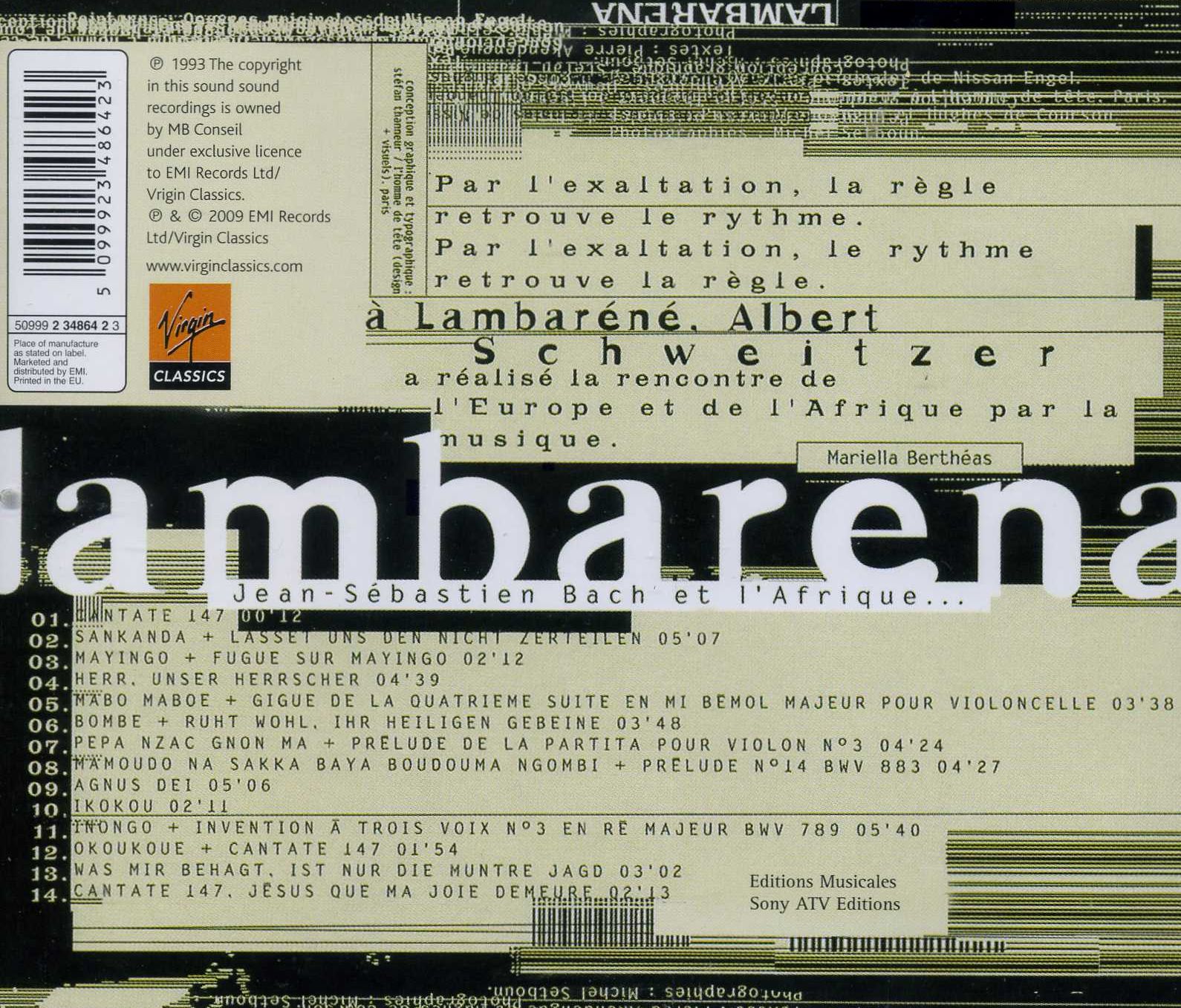
The impulse behind this album, developed by Mariella Berthéas, was to create a tribute to Albert Schweitzer by bringing together the two musical traditions that are central to his life: the works of JS Bach and the musics of Gabon, where he dedicated his life to serving as a medical missionary in the city of Lambaréné. To call this a crossover album, however, would be to misrepresent it; this is not an intelligent synthesis of two disparate traditions. It is difficult to characterize the relationship between the two musical cultures. To say that the musics are "coordinated" falls short of the surprising spontaneity of the juxtapositions, but to say that they are "thrown together" suggests a randomness that underestimates the skill and artistry of the arrangers, Hughes de Courson and Pierre Akendengué. Bach's music and the musical traditions of Gabon co-exist without giving up their own integrity, and interact with varying degrees of obvious connection. The CD includes classically trained European musicians, 10 ensembles from Gabon, and several Argentine musicians, who worked together in the studio for many months to create the album. The most successful songs uncannily capture the underlying musical impulse common to the two traditions, and the result opens up new meanings, and sounds natural and organic. For example, it's amazing, on track 2, how well a traditional Gabonese song fits and overlaps with "Lasset uns nicht den Zerteilen," from the St. John Passion, and how they complement each other in their affirmation exuberant of life. On track 6, the simultaneous performance of a ritual that includes a pattern of clapping and ululating vocalizations and a chorus of the Passion according to Saint John is impressive. Not all efforts are equally successful; the chant at the end of the Agnus Dei of the Mass in B minor simply sounds tacked on. But when the mix works, as it normally does, the effect is revealing and transformative. The sound is intensely clean and very well differentiated, highlighting the wonderful strangeness of the mixture of traditions.

1 Cantate 147 0:13

2 Sankanda (traditionnel arr. P Akendengué) 5:70

3 Mayingo (traditionnel arr. P. Akendengue): Fugue sur Mayingo (T. Gubitsch) 2:12

4 Herr, Unser Herrscher 4:36

5 Mabo Maboe (traditionnel arr. P. Akendengué): Gigue de la Quatrième Suite en mi bémol majeur pour violoncelle 3:38

6 Bombé/Ruht Wohl Ihr Heiligen Gebeine 3:46

7 Pepa Nzac Gnon Ma (traditionnel arr. P. Akendengué): Prélude de la Partitia pour violon no3 4:23

8 Mamoudo Na Sakka Baya Boudouma Ngombi (traditionnel arr. P. Akendengué): Prélude No.14 BWV 883 4:28

9 Agnus Dei (Messe en si BWV 232 — arr. P. Akendengué) 5:60

10 Ikokou (traditionnel arr. P. Akendengué) 2:11

11 Inongo (traditionnel arr. P. Akendengué et H. de Courson): Invention à trois voix No3 en ré majeur BWV 789 5:40

12 Okoukoué (traditionnel arr. P. Akendengué et H. de Courson): Cantate 147 1:54

13 Was Mir Behagt, Ist Nur Die Muntre Jagd (Chorus "La Chasse" — J.S.Bach arr. P. Akendengué et H. de Courson) 3:30

14 Cantate 147 "Jesus que ma joie demeure" (J.S.Bach arr. P. Akendengué et H. Courson) 2:14


enero 17, 2021

Hughes de Courson - Lambarena - Bach to Africa - 1995


El impulso detrás de este álbum, desarrollado por MariellaBerthéas, era crear un homenaje a Albert Schweitzer al reunir a las dos tradiciones musicales que son fundamentales para su vida: las obras de JS Bach y las músicas de Gabón, donde dedicó su vida al servicio como misionero médico en la ciudad de Lambaréné. Llamar a esto un álbum crossover, sin embargo, sería tergiversar ella; esto no es una síntesis inteligente de dos tradiciones dispares. Es difícil de caracterizar la relación entre las dos culturas musicales. Decir que las músicas se "coordinan" no alcanza la sorprendente espontaneidad de las yuxtaposiciones, pero decir que son "lanzados juntos" sugiere una aleatoriedad que subestima la habilidad y el arte de los arreglistas, Hughes de Courson y Pierre Akendengué. La música de Bach y las tradiciones musicales de Gabón coexisten sin renunciar a su propia integridad, e interactuar con diversos grados de conexión obvia. El CD incluye formación clásica músicos europeos, 10 conjuntos de Gabón, y varios músicos argentinos, quienes trabajaron juntos en el estudio de muchos meses para crear el álbum. Las canciones más exitosas misteriosamente capturar el impulso musical subyacente común a las dos tradiciones, y el resultado abre nuevas significaciones, y los sonidos naturales y orgánicos. Por ejemplo, es asombroso, en la pista 2, qué bien una canción tradicional de Gabón encaja y se superpone con "Lassetunsnicht den Zerteilen," de la Pasión según San Juan, y la forma en que se complementan entre sí en su afirmación exuberante de la vida. En la pista 6, la realización simultánea de un ritual que incluye un patrón de palmas y vocalizaciones ululantes y un coro de la Pasión según San Juan es impresionante. No todos los esfuerzos tienen el mismo éxito; el canto al final del Agnus Dei de la Misa en si menor, simplemente suena tachuelas. Pero cuando la mezcla funciona, como lo hace normalmente, el efecto es reveladora y transformadora. El sonido es intensamente limpio y muy bien diferenciada, destacando la maravillosa extrañeza de la mezcla de tradiciones.


1 Cantate 147 0:13

2 Sankanda (traditionnel arr. P Akendengué) 5:70

3 Mayingo (traditionnel arr. P. Akendengue): Fugue sur Mayingo (T. Gubitsch) 2:12

4 Herr, Unser Herrscher 4:36

5 MaboMaboe (traditionnelarr. P. Akendengué): Gigue de la Quatrième Suite en mi bémolmajeurpourvioloncelle 3:38

6 Bombé/RuhtWohlIhrHeiligenGebeine 3:46

7 PepaNzacGnon Ma (traditionnel arr. P. Akendengué): Prélude de la Partitiapourviolon no3 4:23

8 Mamoudo Na SakkaBayaBoudoumaNgombi (traditionnel arr. P. Akendengué): Prélude No.14 BWV 883 4:28

9 Agnus Dei (Messe en si BWV 232 — arr. P. Akendengué) 5:60

10 Ikokou (traditionnel arr. P. Akendengué) 2:11

11 Inongo (traditionnel arr. P. Akendenguéet H. de Courson): Invention à trois voix No3 enrémajeur BWV 789 5:40

12 Okoukoué (traditionnel arr. P. Akendenguéet H. de Courson): Cantate 147 1:54

13 Was Mir Behagt, IstNur Die MuntreJagd (Chorus "La Chasse" — J.S.Bach arr. P. Akendenguéet H. de Courson) 3:30

14 Cantate 147 "Jesus que ma joie demeure" (J.S.Bach arr. P. Akendenguéet H. Courson) 2:14