Radio Salone

Travel Through Music

Post Top Ad

noviembre 23, 2019

Calypso Rose - Far From Home - 2016

Calypso Rose is the ambassador of Caribbean music, living legend of calypso ("kaiso") and soca, the Antillean genre born in the context of carnival (responsorial and polyphonic songs), with both African and European roots that arises in the 19th century (living its heyday towards the decade of the 60s and 70s), and whose origin lies in the urban communities of African origin in Trinidad and Tobago.
Rose McCartha Linda Sandy Lewis was born on April 27, 1940 in the small island of Tobago, Republic of Trinidad & Tobago, in the English Antilles. Today he lives in Queens in New York but returns several times a year to his island to regenerate, he says "I find my African roots in Tobago ...". Daughter of a pastor, Rose begins to sing with 15 years and, since then, she has dedicated her whole life to music, "I have not become a calypso singer, I am born Calypso."
He spent 17 years singing on cruises for an American company before having the opportunity to sing in the world-famous Apollo Theater and Madison Square Garden with two of the greatest exponents of the calypso: Lord Kitchener and Mighty Sparrow.
Calypso Rose is a tireless worker, has written more than 800 songs and recorded more than 20 albums produced worldwide. Compared to Miriam Makeba and Cesária Évora, all the communities in the Caribbean - Anglophone, Francophone or Hispanic - receive her with fervor: she is the only female artist who has been crowned at the famous Trinidad Carnival, already in 1978, and in having taken five times in a row the "Calypso Queen" prize. Calypso Rose is an icon. Her personality, her charisma and her joy of living make her a soul singer. A singer of Soul, Gospel, Blues and of course Calypso, a diva of popular music.
In Far From Home (2016) we find a Caribbean musical parade with changes of rhythm, color and mood, in the purest style of Carnival, which, more than a festive ritual, is the main cultural event of Trinidad and Tobago and personifies the soul as well as the social and ethnic diversity of its population.
The executive production is carried out by Jean-Michel Gibert (who has managed the artist's career since her album A Dirty Jim in 2005). The production is in charge of Ivan Duran, and Drew Gonsalves (of the band Kobo Town) co-writes some of the songs and composes the arrangements. For his part, Manu Chao co-produces and leaves his unmistakable mark by singing in three songs ("Leave Me Alone", "Far From Home" and "Human Race") and playing the charango. The graphic art of the album with illustrations by Maxime Mouysset.

 Calypso Rose is not only a totally unique artist, but also a heroic figure whose whole life is a lesson. "Far From Home" not only reboza of joy, but also bears the ever-conscious conscience of a woman who is still fighting for good, the denunciation of domestic violence in songs like "Abatina" or social injustice in "No Madame" (a song he wrote in the 70s and that has contributed to the evolution of laws regarding the treatment of officials in Trinidad). A woman whose memory goes beyond her own existence, in "I Am African", to encompass the fate of the entire black diaspora, in the same spirit as Bob Marley, whom he knew well and with whom he shared the stage in more than one chance. With her courage, her strength and her humanity, only she could, in these times of global discord and violence, sing a song of love and universal brotherhood as "Human Race".

01. Abatina 
(Manu Chao / Drew Gonsalves / Raphael De Leon) 
02. I Am African 
(Manu Chao / Ivan Duran / Drew Gonsalves / Raphael De Leon) 
03. Leave Me Alone (feat. Manu Chao) 
(Manu Chao / Ivan Duran / Drew Gonsalves / McCartha Lewis) 
04. Far From Home 
(Manu Chao / Drew Gonsalves) 
05. Calypso Queen 
(Manu Chao / Drew Gonsalves / Alan Thomas) 
06. Zoom Zoom Zoom 
(Manu Chao / McCartha Lewis) 
07. Trouble 
(Manu Chao / Drew Gonsalves) 
08. Love Me or Leave Me 
(Manu Chao / Maureen St. John) 
09. No Madame 
(Manu Chao / McCartha Lewis) 
10. Woman Smarter 11. Human Race 
(Manu Chao / Aldric Farrel) 
12. Wah Fu Dance! 
(Manu Chao / Ivan Duran / Drew Gonsalves / McCartha Lewis) 


noviembre 22, 2019

Tanbou Toujou Lou - Meringue, Kompa Kreyol, Voudou Jazz & Electric Folklore From Haiti 1960 - 1981 – 2016

The musical scholar Vik Sohonie, veteran researcher, writer and music editor, has edited Tanbou Toujou Lou as the first work for his own label, Ostinato. A compilation of 19 themes of what he considers the 20 years of the golden age of Haitian music.

Selected from private collections and radio archives in Brooklyn, New York, and on multiple research trips to Port-au-Prince, Jacmel, Gonaïves and Saint Marc (Haiti), the themes represent the diversity of styles that spanned the fundamental years of musical innovation in Haiti. From the legendary and elegant parties of Big Bands in the iconic discos of Port-au-Prince to the rhythms of the countryside; from African sounds like kompa and accordion-driven meringue and drum patterns of voodoo jazz, to hypnotic arrangements of tenor saxophone and psychedelic interpretations of folklore. Amazing examples of their respective genres that have a particularly Haitian and fresh dynamic.

Beautifully packaged and with a libretto that provides prolific information about a music scene that has received little attention, compared to its neighbors in the Caribbean, this is a work done with devotion. Tanbou Toujou Lou may be the most amazing compilation of 2016 so far.

Tracks list:

01. Zotobré - Lagen
02. Les Gypsies de Pétionville - Francine
03. Les Loups Noirs - Bebe Showman
04. Tabou Combo - Gislene
05. Coupé Cloue et Trio Select - La Vie Vieux Negre
06. Rodrigue Milien et Son Groupe Combite Creole - Rapadou
07. Les Loups Noirs - Pele Rien
08. Super Jazz de Jeunes - Erzulie Oh!
09. Nemours Jean Baptiste - Haiti Cumbia
10. Ensemble Webert Sicot - Prend Courage
11. Super Jazz de Jeunes - Lonin
12. Ensemble Etoile du Soir - Tripotage
13. Zotobre - Ochan
14. Chanel 10 - Lola
15. Super Choucoune 70 - Madeleine
16. Les Pachas du Canape Vert - Samba Pachas No. 2
17. Ibo Combo - Souffrance
18. Shupa Shupa - Epoque Chaleur
19. L´Orchestre Radio Nationale D´Haiti - Meci Bon Dieu


noviembre 21, 2019

A Cor do Som ao vivo no Montreux International Jazz Festival - Brasil

The group was founded the color of sound in 1977, experimenting with new sound patterns, based on previous experiences of the Bay News, Moraes Moreira Gomes and Pepeu, and a tropicalist. This post-movement is the second group of A Color discs Sound was released in 1978. The band, based in Rio de Janeiro, Brazil was the first group to be invited to play at the jazz festival in Montreux, Switzerland.

With an exaggerated virtuosity, the group presented almost all the unpublished material. A feature that highlights this album is the first important use of electrical instruments and synthesizers, as in the "Child Jesus" version.

The formation of the group is: Aerosmith, Guitar, Dadi, below; Mu Keyboards and Synthesizers Carvalho, Gustavo Schroeter, drums. It is this record that percussionist Ari definitely among the band. In this show, the color of the Aroldo Macedo sound is also offered on the strings, although its name does not appear on the sheet. Aerosmith's brother, Aroldo do some concerts with the group at that time, but could not establish himself as an effective member. One of the works presented in the repertoire, "Cochabamba" is its own, in association with Moraes Moreira.

Despite the great quality music and great creativity of the band, the album, like its predecessor, had very low sales, which leads to the pressure of the group AEM members of the band to pass the present In addition to the usual instrumental pieces, sung songs. This formula was adopted, with some reluctance, the next album, "fruitful", and had a remarkable success, so as a whole to achieve great commercial success in the 1970s and early 1980s.


1-Dança Saci (Mu)
2-Chegando da Terra (Armandinho)
3-Arpoador (Dadi/Mu/Gustavo/Armandinho)
4-Cochabamba (Moraes Moreira/Aroldo Macedo)
5-Brejeiro (Ernesto Nazareth)
6-Espírito Infantil (Mu)
7-Festa na Rua (Dadi/Gustavo/Armandinho/Mu)
8-Eleonor Rigby (Lennon/McCartney)


noviembre 20, 2019

Virgínia Rodrigues - Mama Kalunga – 2015

Mama Kalunga is the fifth album by Virgínia Rodrigues, a mythological and earthly narrative about the black presence in Brazil and in the World and which has won her the "Best MPB Singer" award at the 27th Brazilian Music Awards.
Tiganá Santana, producer of the album with Sebastian Notini, writes in the album's presentation text: "sujo de mud e espírito". It is the synthesis of the album, released seven years after the previous Recomeço (2009). In its dilated 56 minutes, from the first to the last cut, it is presented as a mythological and earthly narrative, philosophical and affective, of the black roads through the Earth and its trail of mud and spirit.

Its opening, a cappella, announces it. In "Ao senhor do fogo azul" (Gilson Nascimento), directed to Nkosi / Ogum (the warrior and forger entity to whom she dedicates the album) Virgínia evokes the "Essence of Everything" with "To or world to be / To be no world". A ritualistic tone that goes on in the second theme, "Mama Kalunga" (Tiganá Santana), this time a prayer to the "mother of water", to whom she introduces herself saying: "Eis-me aqui / Serei eu a voice that never be. " The loudness is chamber music, with atabaque, cellos and violão-tambor (instrument modified by Tiganá) that condenses this proposal of the disc, tuned on different levels with the guitars of Dorival Caymmi and João Gilberto.

After asking permission from the Lord of Fire and the Lady of the Water, Virgínia deepens her ritual (in the mud and in the spirit) away from ritualism, leaving the direct reference to the Orixas and falling into the reading of the cosmos proposed by Paulinho da Viola in "Nos horizons do mundo", which links the movements of the universe to the solitary thinking of each person "to overcome loneliness". Once again, the guitar and the cello (with an insert of "Choro negro", also by Paulinho) treat the blackness with delicacy.

The album continues to alternate declared religious themes (the santeria of "Traditional Afro-Cuban / Belen Cochambre", with the voice of Susana Baca) or Afro nuance (there are songs of Tiganá in the African languages ​​kikongo and kimbundo) with themes that expand in a way indirect that look on the sacred. "Teus olhos em mim", by Roberto Mendes and Nizaldo Costa, is a romantic song that approximates the eyes of the beloved person (and the other eyes that can carry themselves) and the water eyes of the stream. In "Sou eu", by Moacir Santos and Nei Lopes, the lover puts on as "lila flash" and "teu Ogum Megê". "Luandê" (by Ederaldo Gentil) refers to Africa, and joins the guitar of Bernardo Bosisio (fundamentally his participation in the album), with verses such as "Neste mundo, todo mundo / Tem um nego na famia".

Like the afoxé "Luandê", "Vá take care of your life" (by Geraldo Filme, already significantly rewritten by Itamar Assumpção) addresses another transversal issue of the album in arrangements and lyrics: the white / black dichotomy. Treated here with acid humor and samba de roda, it translates into images like the black who goes to mass while the white goes to the macumba, a slight and incisive portrait about a deep cultural dynamic, forged, again, in mud and spirit, in the special voice of Virgínia. (Source: O Balloon)

Tracks list:
01. Ao senhor do fogo azul
02. Mama Kalunga
03. Nos horizontes do mundo
04. Vá cuidar de sua vida
05. Babalaô/amor de escravo
06. Mukongo
07. Teus olhos em mim
08. Cântico tradicional afrocubano/Belén Cochambre (feat. Susana Baca)
09. Mon´ami
10. Luandê
11. Yaya zumba (feat. Ruth de Souza)
12. Sou eu (feat. Tiganá Santana)
13. Dembwa (10 de agosto)


noviembre 19, 2019

N.O.H.A. - Circus Underground

N.O.H.A. "Noise Of Human Art", is a cosmopolitan band of electronic music and world music formed in Prague (Czech Rep.) In 1995, since then the collective has not ceased to create, experiment and innovate, while growing as a brand and movement, instilling its own philosophy of life "Circus Underground". This is how his fifth album, which they now present to us, is titled, has been awarded as one of the best European live bands. Hits like "Tu Café", "Balkan Hot Step" or "Di-Nero" from his recent album, have gone around the world, leading the band to perform in the most important stages.

When they are on stage, N.O.H.A. It stands out as a living being, a tornado that breathes. The band emits a highly contagious positive energy that navigates the atmosphere of their concerts. N.O.H.A. pulverize the boundaries between different genres of music such as jazz, D&B, hiphop, funk, balkan, flamenco, brasilian beats, swing or afro and thus connect naturally with a dynamic groove, trancero, cheerful and playful, always with an omnipresent base of electronic, dubbies and powerful bass. Hence they have been mentioned as the creators of Ethno-Bass. This force that has the band has been increased thanks to the presence of the American singer Kaia Brown, whose voice, charming, unique, adds a new dimension to the music and the live NOHA. After consecrating this summer 2014 in our land after the performances at the Alrumbo, Reperkusión and Fuerteventura in Music festivals, and the great demand, N.O.H.A.

Training:

Philip Noha (Prague, Czech Republic) co-founder, producer, composer and saxophonist
Kaia Brown Voice (NY, USA)
MC Chevy (NY, USA) lyricist, voice co-founder
Thom Herian (Prague, Czech R.) Drums, and dancing
Jatrabass (R. Czech) bass player.

1. Ants 06:08 
2. Di Nero 03:32 
3. Family 04:50 
4. Park of lllusion 06:17 
5. Jungle Nuttah 04:46 
6. Wanna play?! 03:49 
7. Yemanja 07:15 
8. Way 01:3


noviembre 18, 2019

Hypnotic Brass Ensemble - Book Of Sound

Hypnotic Brass Ensemble (also known as The Bad Boys of Jazz) is an eight-piece, Chicago-based brass ensemble consisting of eight sons of the jazz trumpeter Phil Cohran. Their musical style ranges from hip-hop to jazz to funk and rock, including calypso and gypsy music. They call their eclectic blend of sound "now music", or "Hypnotic". Reared in the teachings of music since they were children, they grew up on the stage playing as the "Phil Cohran Youth Ensemble".


1 Lead the Way 3:13
2 Purple Afternoon 6:07
3 Kepra 5:58
4 Morning Prayer 4:24
5 Now 6:19
6 Solstice 4:16
7 Midnight 4:57
8 Sri Neroti 4:06
9 Heaven and Earth 4:34
10 Synapsis 4:49
11 Royalty 3:11

noviembre 17, 2019

3MA - Ballaké Sissoko, Driss El Maloumi, Rajery – Anarouz - 2017

Since their debut album in 2008, 3MA musicians have gone through many individual experiences expanding their knowledge.

They meet regularly to give 3MA concerts around the world and over the years, new ideas have emerged, which have then been refined, resulting in new compositions or reworking existing ideas.

A decade after the beginning of his adventure, it was time to take stock and return to the recording studio. This new album is witness to his wonderful connection and mature experience. The percussionist Khalid Kouhen joins two tracks to add delicate pulses with his Pakistani percussions and Indian tables, and in two other tracks we can even listen to Rajery, Driss and Ballaké singing.

But for the rest of the record, string instruments reign and weave their magic alone. Each piece is the result of a unique chemistry in which individual parts are difficult to define. The sounds of kora, oud and valiha do not attempt to stand out from each other, but instead develop a common language. While we never lose sight of the rich traditions that Ballaké Sissoko, Driss El Maloumi and Rajery represent, we listen above all to a shared message of 3MA, a message that manifests itself against the violence of our world, with its soft and invigorating harmonies, vital energy and universal poetry.

TRACK LIST
Anarouz
Samedi glace
Anfaz
Moustique
Hanatra
Lova
Mariam
Aretina
Jiharka
Awal


noviembre 16, 2019

Melanie De Biasio - Lilies

Born to a Belgian mother and an Italian father, Mélanie De Biasio learnt ballet from the age of three, and started playing the Western concert flute at eight. At the age of 12, she joined the Ensemble de l'Harmonie de Charleroi with whom she toured Canada for a month. During her adolescence, she further improved her voice and diction. 
Being a fan of groups like Nirvana, she sang and composed in English in a rock band at age 15. She played in several groups before totally setting her mind to jazz with the trio Harmadik Fül. With them, she learnt to improvise while discovering the many facets of music. After three years of singing studies at the Royal Conservatory of Brussels, she was awarded a first prize with a distinction degree. After that, she toured in Russia, in which she gained further professional experience. This is when Steve Houben (Belgian jazz musician and saxophone professor at the Conservatory) asked her to appear in concert with him, allowing her to play in numerous festivals and other large music events in Belgium.

1. Your Freedom Is The End Of Me 03:50
2. Gold Junkies 03:19
3. Lilies 04:02
4. Let Me Love You 04:08
5. Sitting In The Stairwell 02:49
6. Brother 03:11
7. Afro Blue 04:33
8. All My Worlds 06:40
9. And My Heart Goes On 06:00 

noviembre 15, 2019

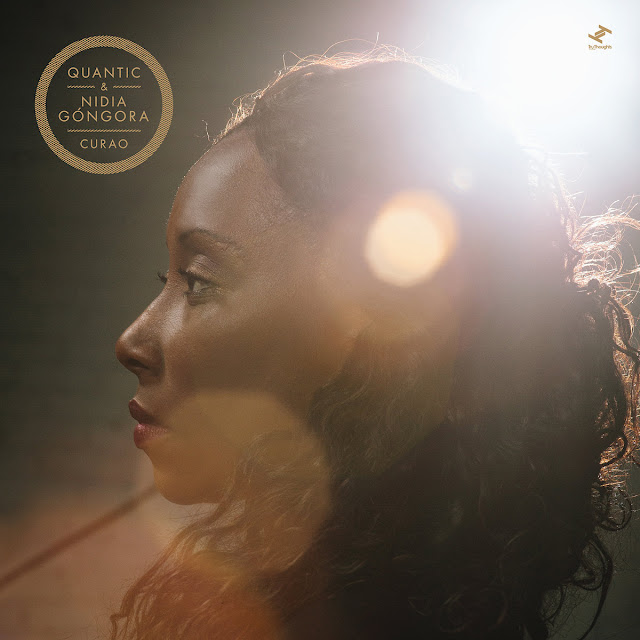
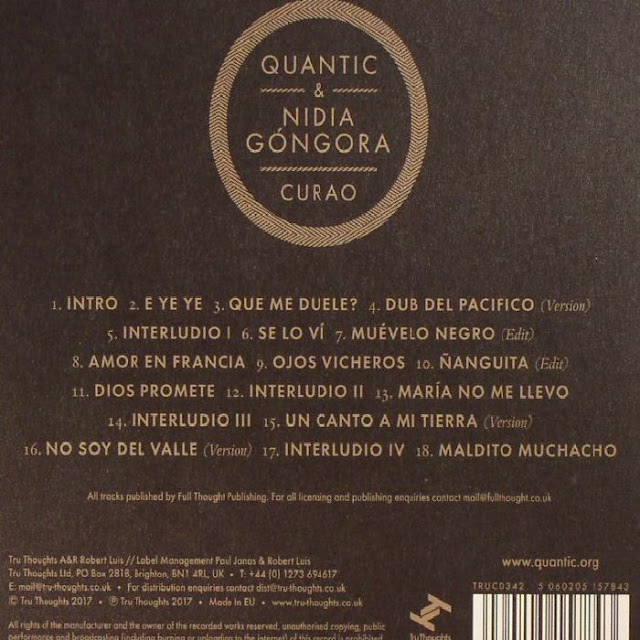
Quantic & Nidia Góngora - Curao


Curao (2017) means the culmination of a creative association that has been sparkling for a decade, the union between music lover, explorer and sound nomad William "Quantic" Holland and the sublime Nidia Góngora, a magical album, as visceral as spiritual. A new and very original interpretation of the unique, rich and mystical musical traditions of the Colombian Pacific Region.


Curao is the place where the ancestral sound of Pacific folklore is mixed with subtle dyes of electronic arrangements. A sound space where the marimba de chonta (piano of the jungle) is twinned with the downtempo, where the currulao coexists with the dub, where the chirimía and the airs of drum & bass intersect, mix.


In this creation of 18 songs is the jungle, the brave river, the rain; coconut rice, borojó, crabs, shrimp, viche; religion, lullabies, redemption; the marimba de chonta, the drummers, the metallic winds. All in a description that is pure magical realism where the landscapes of the deep Pacific are painted. A trip to the ancestral with a modern sound in which it is clear that the Quantic-Gongora union will always bring us sound magic to abstract us into deep and mystical jungles.

01. Intro
02. E Ye Ye
03. Que me duele?
04. Dub del Pacifico
05. Interludio I
06. Se lo ví
07. Muévelo Negro
08. Amor en Francia
09. Ojos Vicheros
10. Ñanguita
11. Dios promete
12. Interludio II
13. María no me llevo
14. Interlucio III
15. Un canto a mi tierra
16. No soy del Valle
17. Interludio IV
18. Maldito muchacho


noviembre 14, 2019

Criolo - Espiral de Ilusão

Criolo Doido is originally from the Grajaú neighborhood, (São Paulo). He began rapping in 1989, but until the beginning of the 2000s he was virtually unknown. He worked as an educator between 1994 and 2000. In 2006, he released his first studio album, titled "Ainda Há Tempo". The songs “RAP é forte”, Morto Vivo, Ainda Há Tempo, Até Me Emocionei (with Bastardo, former member of SNJ) and Chuva Accida stand out. In that same year he founded the Rinha dos MC's existing until today. It includes freestyle battles, weekly concerts, graffiti exhibitions and photographs. The following year, he participated in the "Som Brasil Especial" in homage to Vinícius de Moraes; and he was nominated for the Hutúz Prize in two categories: "Grupo ou Artist Solo" (who lost to GOG) and "Revelação" (defeated by U-Time). In 2008, he received the "Song of the Year" and "Personality of the Year" award in the fourth edition of the "O rap é compromisso" event.

The following year, he was again nominated for the Prêmio Hutúz in the category "Revelations of the Decade", but he did not win. He participated in the documentaries "Profissão MC", by Alessandro Buzo and Tony Nogueira; and "Da Luz às Trevas", by Ney Matogrosso. To commemorate his twenty-year career, he recorded a live DVD in the "Rinha dos MC's", which was released for sale in 2010, called "Criolo Doido Live in SP". At the end of the year, Criolo released a single CD, with the songs "Grajauex" (tribute to his neighborhood) and "Subirusdoistiozin", recorded in studio, with the production of Marcelo Cabral and Daniel Ganjaman and with instruments such as guitar, bass, piano and trumpet, giving indications of a small modification of his style. Both songs were announced as presents not their next album, through the launch concert held at the Matilha Cultural. A few days later, the video clip of "Subirusdoistiozin" was released on the internet, lasting more than 6 minutes.

In 2011 he released his second album, "Nó na Orelha" (Knot in the ear), free of charge through the internet and abbreviated his stage name to "Criolo". On the album, the singer diversified the rhythms of rap with several others, such as MPB, funk, soul and blues. This album had excellent reception by critics (including foreigners), leading Criolo to participate in the "High Hours" program of the "Rede Globo" and to be on top of the trending topics of twitter. With the album, Criolo was one of the MTV Brazil Music Music 2011 champions, in the "Video Clip of the Year" categories, with "Subirusdoistiozin", "Artist of the Year", "Album of the Year", with "Nó na Orelha "(won)," Music of the Year "with" There is no love in SP "(won), and as" Banda ou Artist Revelation "(won). He was also the first confirmed to perform live during the awards, where he sang the song "There is no love in SP" with Caetano Veloso.

1. LÁ VEM VOCÊ
2. DILÚVIO DE SOLIDÃO
3. MENINO MIMADO
4. NAS ÁGUAS
5. FILHA DO MANECO
6. ESPIRAL DE ILUSÃO
7. CALÇADA
8. BOCA FOFA
9. HORA DA DECISÃO
10. CRIA DE FAVELA


noviembre 14, 2019

Rio Mira - Marimba Del Pacifico

In 2014, the creative impulses of Colombian producer Iván Benavides joined those of Ecuadorian Ivis Flies. The result was Río Mira, a super group of all stars that included musicians from the Colombian and Ecuadorian Pacific and that precisely bears the name of the river that both nations share, which is born in Imbabura, Ecuador and ends in Nariño, Colombia.

What three years ago was formed as an idea, shared territory and explored the sonority of a particular mutual geography, today it famously receives the fruits of its work materialized in a 12-song album published by AYA Records and baptized in a minimalist way, but successful, Marimba del Pacífico: a title that contains much more than an instrument and a place on the map, the backbone and the inspiration of more than a dozen musicians who were part of the process, including Esteban Copete, Karla Kanora, Hugo Quiñonez, Larry Preciado and Eduardo Martínez among others.

Marimba del Pacífico could well be understood as an anthology of stories born from the oral tradition that inhabit both territories that were immortalized musically, as if they were photographs, portraits of these enchanting landscapes. It is a sometimes mystic jungle disk and other times partisan vindicator.

Songs like 'Adiós Morena', standard of the Colombian Pacific folklore, 'Agua', 'Rconca Canalete' and 'They were crying', are presented as a lament in the form of a lullaby, of moments and experiences that are there, forming the most melancholic landscape , while 'Guarapo', 'Patacore', 'Whirlwind' and 'Adarele Andarele', represent the most fierce and frenetic spirit of both nations.

And a couple of songs like 'Aguacerito' that acts as an interlude cobijador and 'Chicungunya' that closes the album with another one of those experiential narratives in the territory.

In short, it is an album that celebrates the marimba de chonta and the piano of the jungle as the tool to tell and twin two nations through music in a magnificent creation.


noviembre 11, 2019

Amadou & Mariam - Dimanche à Bamako - 2004

Mali has always been an intercultural meeting place between Arabs and Berbers from the north and people from South West Africa. That is why it has a rich and varied cultural life. His musical site is impressive: Salif Keita, Ali Farka Touré, Toumani Diabaté, Oumou Sangaré, Ballaké Sissoko, Tinariwen, Bako Dagnon ... are part of his cast of living legends. And, for some years, Amadou & Mariam. Dimanche à Bamako (2004), a record produced by Manu Chao, marked his rise to international fame. By then they had been singing together and reaping success in West Africa for thirty years with their hypnotic and bright blues, the "afro-blues."

Mariam Doumbia and Amadou Bagayoko were born in Bamako, capital of the country. Both lost their sight in childhood, and turned to music from their earliest age and it was music that joined them, in 1975, at the Institute for the Blind Young of Bamako in 1975. Since then they have never separated, nor when they emigrated to Abidjan (Ivory Coast), nor when they left for France, nor when international fame and recognition came.

Between 1974 and 1980, Amadou was part of the Les Ambassadeurs du Hotel group. Mixing African, Cuban, Indian, jazz, reggae, blues and pop influences, Amadou & Mariam made their way into the gigantic panorama of African artists. During the 90s they live a first season in Paris. They record a first album, Sou Ni Tilé, whose single "Je Pense A Toi" sells more than 100,000 copies in 1998 in the neighboring country. Follow a second album and a series of tours in Europe and the USA. In 2003, Manu Chao, already separated from Mano Negra, falls in love with his music and collaborates with them in the composition of a new album, Dimanche à Bamako, which comes out in 2004. The album, a small jewel of Malian music for western ears , receives many awards, in the United Kingdom and France among others, where more than 300,000 copies are sold.

The album opens at a rhythm with "M´Bifé", one of the six songs that Manu Chao co-writes with the African couple. But it is not until "Coulibaly" and "La Réalité" when Dimanche à Bamako takes flight with a mixture of African rhythms with the most modern electric instruments (guitar, keyboards, programming) and traditional (djembé, flute and percussion).

Registered between September 2003 and April 2004 in recording studios in Bamako and Paris, in addition to some sessions in a Mopti camp hotel, the fifteen songs of Dimanche à Bamako marked a quality leap in the contagious sound of Amadou & Mariam, which to date had published three large albums, Sou Ni Tilé (1998), Tjé Ni Mousso (1999) and Wati (2002), as well as several cassettes for the African regional market.

The reception of the album was unbeatable: he achieved the top positions of the European music charts of the world, and people, in addition to the renewed African sound of the Mali couple, continue to discover in "Sénégal Fast Food" one of the best songs that Manu Chao He composed in French from Mano Negra. A beautiful disk. A story to repeat.

Tracks list:
01. M´Bifé
02. M´Bifé Balafon
03. Coulibaby
04. La Réalité
05. Sénégal Fast Food
06. Artistiya
07. La Fête au Village
08. Camions Sauvages
09. Beaux Dimanches
10. La Paix
11. Djanfa
12. Taxi Bamako
13. Politic Amagni
14. Gnidjougouya
15. M´Bifé Blues


noviembre 04, 2019

Afro Celt Sound System - The Source - 2016

Global sound with artists from Europe and Africa have been the food of the Afro Celt Sound System project, an Afro-Irish group formed by Simon Emmerson (guitarist and producer), N'Faly Kouyate (kora and balafon), Johnny Kalsi (percussion), Moussa Sissokho (percussion) and Griogair Labhruidh (flutes, vocals and guitars), being part of the group, also, James McNally (multi-instrumentalist), Iarla Ó Lionáird (voice), Emer Mayoc (bagpipes) and Martin Russell (keyboards and programming), true architect of its sound.
Although Simon Emmerson had formed the band in 1991, it was not until 1996 when they made themselves known at the Womad festival, where they had extraordinary success. From that date on, their level of quality and innovation rose to the same extent that they released their six studio albums, Sound Magic (1996), Release (1999), Further In Time (2001), Seed (2003), Anatomic (2005 ) and The Source (2016), which celebrates its 20th anniversary and has won them the Best Group award at the 2017 Songlines Music Awards.

In these works, in addition, they have enjoyed the collaborations of artists such as Robert Plant, Sinéad O'Connor, Davy Spillane, Liam O'Flynn and Peter Gabriel, among others. The latter, founder of the Womad festival and owner of the Real World label, label that has published the first five albums of the group. They have also participated in films such as "Hotel Rwanda", "Stigmata", "Gangs of New York" and "Nikita".

Afro Celt Sound System fuses dance and electronic music in general, with Celtic and African rhythms, synthesizing the ideology of Womad: mixing cultures, using contemporary technologies - they work with computers - and taking care of the visual aspect, especially dance. His repertoire includes sheet music from 600 years ago and current pieces such as jungle and house. This perfect mix of ancient and contemporary sounds, what they call global dance, has placed them in the undisputed vanguard of World Music.

Tracks list:

01. Calling in the Horses
02. Beware Soul Brother
03. The Magnificent Seven (ACSS meets TDF)
04. Cascade
05. A Higher Love (tune "Monkswell Road")
06. Honey Bee
07. Where Two Rivers Meet
08. Mansani Cissé/Tàladh
09. Child of Wonder
10. Desert Billy (tune "The Balcony")
11. The Communicator
12. The Soul of a Sister
13. Kalsi Breakbet


noviembre 03, 2019

Tinariwen - Elwan - 2017

Elwan is the seventh studio album by the mythical Tinariwen, an emblematic group of the so-called desert blues that has been active for more than three decades and whose bands, such as Terakaft, Tamikrest or Bombino, recognize them as their greatest influence. True to his idiosyncrasy, but also forced by the often bloody agitation prevailing in his Saharan home, the referential band Tuareg acts, composes and records in a changing way, depending on the circumstances, but always marked by the sensation of the lost land. This time they recorded this album in California (curiously in a place of family connotations for the rock fans such as Joshua Tree National Park) and completed it at M’Hamid El Ghizlane, an oasis in southern Morocco. Appropriate dichotomy that reflects the content of the album.

"Elwan" means "elephants" and is a metaphor for describing those beasts that trample on everything around them. It is a vital album with songs of struggle, songs of hope and with that clean and characteristic sound of the Stratocaster guitar, in addition to the deep voices of its two main singers and composers Ibrahim Ag Alhabib and Abdallah Ag Alhoussenyi. The eleven compositions of the album offer their greatest virtue in the contrast between vigorous and relaxing themes: it opens with "Tiwàyyen", a blues with its swell of guitar stitches that ends those accelerations typical of the Gnawa rhythms (which brings memory to the group beginnings); in "Sastanàqqàm" the cyclical and hypnotic guitars seem to sing along with the band's choirs, and the clash with the reality of the band and its surroundings is evident in "Ténéré Tàqqàl", sad and spiritual regret for the sacking of their land. "Imidiwàn n-akàll-in" refers us to the solitude of the desert to, again, return with acoustic guitars and vibrant percussion in the "Assàwt" envelope. The album closes an emotional blues, "Nànnuflày", an abrasive theme about the vastness and emptiness of the desert.

With the notable collaborations, in addition, of influential American musicians such as Kurt Vile, Mark Lanegan and Matt Sweeny, in Elwan the band has managed, once again, to collect in the studio the fascinating trance of their live shows.

Tracks list:
01. Tiwàyyen
02. Sastanàqqàm
03. Nizzagh Ijbal
04. Hayati
05. Ittus
06. Ténéré Tàqqàl
07. Imidiwàn n-àkall-in
08. Talyat
09. Assàwt
10. Arhegh ad annàgh
11. Nànnuflày


noviembre 01, 2019

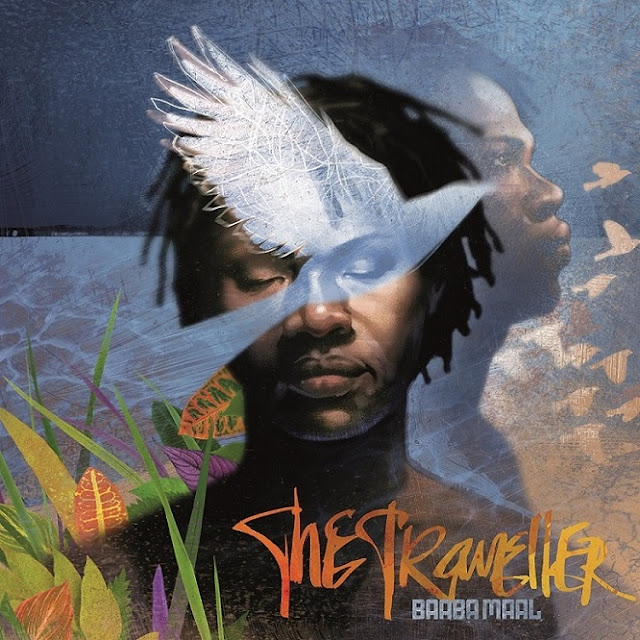
Baaba Maal - The Traveller - 2016


Senegalese singer, songwriter and guitarist Baaba Maal is at the forefront of the most avant-garde, combative and electrifying African music. He shows it again in his new work, The Traveler (the eleventh of his career) engraving on horseback between Senegal and London, a work of an artist with deep roots and a look set on the most creative musical horizons.


Baaba Maal had not recorded an album for six years, but during this time he has not remained idle. UN cultural ambassador, has directed an annual music festival, Blues du Fleuve, in his hometown of Podor in northern Senegal since 2006, and has been participating in the international project "Playing for Change", a multimedia music project and also a Foundation with the objective of gathering, recording and filming musical artists from different cultures.

Maal began his musical career with his friend Mansour Seck, blind guitarist and griot of his family, when he founded the group Lasli Fouta. In Paris they record the album Djaam Leeli in 1984, and on his return to Senegal he founded a new group, Dande Lenol. His first influences come from American R&B and soul, although he soon found his own style fusing the traditional music of his people with pop and reggae. In 1988 he published his first solo album, Wango, the first in a series of highly successful albums that also includes Baayo of 1991, Lam Toro of 1992, Firin'in Fouta of 1994, and Nomad Soul (1998). Jombaajo appeared in 2000, followed by Missing You (2001) and Television in 2009.

After a long career, it was almost inevitable that Baaba Maal would title any of his albums The Traveler. For him, travel and music are inseparable since he first left his hometown almost 40 years ago and has not stopped since then. His new work is a travel diary, "a beautiful and exciting celebration, meeting new places, finding unknown people until then and making good music with them," as he has acknowledged. In this sense, The Traveler evokes the pleasures of the trip and the satisfaction of returning home, "No matter how long I can be away, where I am, and what I am doing, I will always return to Fouta to feed my soul."

Maal has entrusted the work of production to Johan Hugo (The Very Best), an expert when it comes to translating African sounds into current trends. That means that the polyrhythms charge weight between tribal and danceable, and that traditional instruments coexist with fierce electric guitars (for example, the powerful "Fulani Rock", impressive start of the disc where there are them) and with silky keyboards ("One day ").

Other songs like "Kalaajo" propitiate a beautiful encounter between arpeggiated acoustics and electric guitars that could well come out of a Tinariwen record. The song that gives title to the album takes us back to the eighties afropop that brought so much victory to Maal, with the added curiosity of Winston Marshall's banjo (Mumford & Sons).

The duo of final songs, symbolically titled "War" and "Peace", are dominated by the recitations of the poet Lemn Sissay. The first of the pieces is abrupt, both in the interpretation of Sissay and in the instrumentation that surrounds it, in clear contrast to the delicate atmospheres that soften the message in the subsequent "Peace". The message is relevant and it is clear, Maal giving priority to his social work over that of a musician, to celebrate and preserve his people, his culture and the Fulani language.

01. Fulani Rock
02. Gilli Men
03. One Day
04. Kalaajo
05. Lampenda
06. Traveller
07. Jam Jam
08. War
09. Peace