Radio Salone

Travel Through Music

Post Top Ad

Mostrando entradas con la etiqueta Mali. Mostrar todas las entradas
abril 10, 2025

Mali - 2005


La presente edición de Putumayo es una estupenda oportunidad para introducirse en la riqueza musical que nos aporta Malí. Malí ha sido, de siempre, un sitio de encuentro intercultural entre árabes y bereberes del norte y gente de la África Occidental del Sur. Es por ello que posee una vida cultural rica y variada. Su música tiene raíces en antiguas tradiciones como la del griot, trovador cuyo oficio se transmite de generación en generación y cuyas canciones épicas y de alabanzas generalmente datan de cientos de años atrás. Cada región y cada tribu de Malí tiene su propio estilo y expresión musical en constante evolución, incluyendo el blues del desierto de los nómadas tuaregs; los frenéticos ritmos y voces de la música wassoulou del sur, y los conmovedores compases de la música de los bamabara. Instrumentos tradicionales como la kora (arpa africana), el n´goni (similar a una guitarra), el balafón (xilofón hecho de madera y calabaza) y el tamana (tambor parlante) se combinan con sonidos de guitarras, teclados y baterías en la música maliense. Por su parte, la música afro-cubana, el blues, el hip-hop y el rock también han hecho su particular aporte a la música de Malí.

El resultado es una música con un aura irresistible y distintiva, con reminiscencias del blues que le hace poseer un sonido familiar que atrae a toda clase de públicos.


tracks list:

01. Moussa Diallo • Maninda

02. Habib Koité & Bamada • Kanawa

03. Idrissa Soumaoro • Ouili Ka Bo

04. Tinariwen • Amassakoul 'N' Ténéré

05. Ramatou Diakité • Gembi

06. Kélétigui Diabaté • Koulandian

07. Tom Diakité • Fala

08. Boubacar Traoré • Kanou

09. Issa Bagayogo • Bana

10. Mamou Sidibé • Bassa Kele

11. Habib Koité & Bamada • Saramaya (Live)


enero 05, 2022

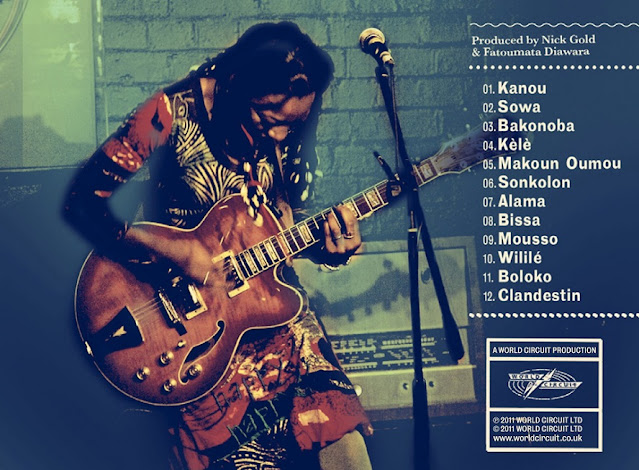
Fatoumata Diawara - Fatou - 2011


Fatou is the first album and the name by which Fatoumata Diawara is known, an actress and singer from Mali living in Paris, sponsored by the prestigious Alí Farka Touré and Oumou Sangaré label, World Circuit. Her magnificent voice acts as a great protagonist, with her own songs that convey folk melancholy and pop sound that naturally integrates ngoni or pumpkin.


Born in Ivory Coast to a Malian family linked to the world of art and dance in the mythical Wassoulou region of western Mali, Fatou became well known for her participation in films that have been very popular in western Mali. Africa (Mali, Guinea, Senegal and Burkina Faso). She also began in the artistic world participating in various theatrical productions, in her country and in France. In Paris, she Fatoumata sang in bars, where she was discovered by Cheikh Tidiane Seck, a magnificent composer and producer (of artists such as Salif Keita, Dee Dee Bridgewater or Oumou Sangaré). With the help of this popular Malian keyboardist and composer, she returns to Bamako and participates in various musical projects: both on the album Seya by the wonderful Oumou Sangaré and on the album by the Afro-American jazz singer Dee Dee Bridgwater, Red Earth. Her silky contemporary voice is also on recent records by Cheikh Lô, Afrocubism and Herbie Hancock.


After learning to play the guitar (encouraged by Rokia Traoré) and composing a good collection of songs, she made her debut for the prestigious British label World Circuit by the very hand of Oumou Sangaré, to whom she lovingly dedicates "Makoun Oumou", a guide and a role model when it comes to women's liberation ideals.


With the production of magician Nick Gold, she records twelve pieces in which her crystalline voice stands out. In her mix of styles, "Kanou" exudes sweetness with her message of the need for love as a restorative function of loneliness, the same tenderness that she shows to talk about the drama of emigration in "Clandestin". "Boloko" is a plea against female cutting; in "Bakonoba", it is an Afro-jazz electric guitar that surrounds a reflection on how cruel words are sometimes; On the other hand, in "Sowa", "Sonkolon" and "Alama", it is the cry of her deep voice that flies over a recollection that aims to encourage mothers not to abandon their children and highlight the suffering of the and the orphans, or the one that she had to live to change her destiny. Nothing escapes the dissection of an outstanding voice that certifies a magnificent album. 


Tracks list:

01. Kanou

02. Sowa

03. Bakonoba

04. Kèlè

05. Makoun Oumou

06. Sonkolon

07. Alama

08. Bissa

09. Mousso

10. Wililé

11. Boloko

12. Clandestin


noviembre 21, 2021

Issa Bagayogo - Timbuktu - 2002


Singer-songwriter Issa Bagayogo offers an innovative take on the rich musical tradition of Mali, his native land, combining his roots based on acoustic textures with the sounds of electronic music and dub. The result is one of the most personal and original fusions between West African traditional music and electronic music that can be found today, adding to that movement that has been called "afro-electro".


Released by Six Degrees, Timbuktu's recording began in Mali, where Bagayogo began to incorporate funky bass lines and electronic beats into the rich Wassulu tradition (century-old culture of the south-west of the country). Along with his ngoni, his velvety voice and with the production of Yves Wernert, Issa's songs are about community issues and social denunciation.


The most compelling aspect of Timbuktu is the way the rhythms come together, both those that belong to a western context of club music and the traditional sounds of griot music. "Baro", with its blues guitar, catchy backing vocals and acoustic yet contemporary sound, is a good example of this. "Sisi", which is about drug abuse by youth, begins with the ngoni and includes the balafon, traditional drums, a wind section and soft female choirs. "Tounga" has the sound that defines the Current Afro-pop: sharp electric guitars, rock tempo and a vibrant bass; it is in this song that Bagayogo sings about emigration and the fight for cultural and artistic integrity.


"Dambalou", a song composed in honor of the warriors who built the Mandingo empire, has been thoroughly worked, with a slowed electronic rhythm, an excellent acoustic guitar solo, and the sounds of Brazilian samba. On the other side of the musical spectrum of this album is precisely the piece that gives title to the album, "Timbuktu", which has a sound full of blues, timeless, even with a touch of Arabic roots, drinking from the same musical influences that other great figures from Mali such as Ali Farka Touré and Habib Koité. Bagayogo's lyrics idealize Timbuktu as a multi-ethnic city, where Muslims, Christians and people from different ethnic groups in Mali live together in harmony.


"Gnele" has an electronic rhythm that already sounds like a mix for dance floors. "Nogo" ("Pollution") has one of the most sophisticated productions of the work, thanks to the combination of traditional instruments and Issa's voice. "Saye Mogo Bana" is a fusion of acoustic and digital percussion, electric and acoustic strings, modern production techniques, and a timeless theme, "death makes flesh disappear, but not your name." And "Dama", the piece that closes the album and that also deals with death, is a party that manages to offset the weight of acoustics and electronics, recalling one of the oldest traditions in Mali: the drums that serve to mark funerals.


The late Charlie Gillet, one of the great BBC personalities who promoted the "BBC Radio 3 Awards for World Music", said at the time of Issa Bagayogo: "The more I listen to his music, the more I think it is destined to become a classic. of African music in general and of the Malian scene in particular ". 


Tracks list:

01. Sisi

02. Baro

03. Tounga

04. Nogo

05. Timbuktu

06. Dambalou

07. Toroya

08. Saye Mogo Bana

09. Banani

10. Gnele

11. Tamagnoko

12. Dama


febrero 22, 2021

Nahawa Doumbia - Kanawa - 2021


El nuevo álbum de Nahawa Doumbia, Kanawa, captura de manera concisa este momento actual en la historia de Malí.


La cantante, cuya dilatada carrera abarca más de cuatro décadas, reflexiona sobre la crisis migratoria desde la perspectiva de Malí en el título de su nuevo álbum Kanawa. A través de ocho canciones grabadas en Bamako con una banda que incluye instrumentos tradicionales y modernos, Doumbia fusiona sus primeros trabajos que se basaron en una expresión sobria de su característico ritmo didadi con el rango grandilocuente del pop contemporáneo de Malí. El acompañamiento musical maravillosamente complejo que resulta es cortesía del gran conjunto que reunió con el productor y arreglista (y colaborador del primer día) N’gou Bagayoko.


La banda cuenta con dos instrumentos de cuerda malienses muy expresivos, el ngoni y el kamalé ngoni un poco más pequeño, así como una variedad de percusión, programación de batería, karignan (un raspador de metal) y guitarras acústicas y eléctricas. La hija de Doumbia, una cantante famosa con su propio grupo y una apretada agenda de conciertos, Doussou Bagayoko canta en "Adjorobena", una canción sobre la paciencia, la tolerancia y la vida en paz. Doumbia teje una hoja de ruta de su psique cuando se trata de lo bueno y lo malo que la vida tiene para ofrecer.


Habla sobre el matrimonio y las mujeres que salen de casa para reunirse con otras a través de la metáfora de un árbol en el jardín; incluye muestras de disparos en la canción "Foliwilen" para honrar la valentía de cazadores, soldados y otras personas valientes; usa un pájaro en "Djougoh" para hablar de la gente perezosa; y, en “Ndiagneko”, aconseja a la gente que ignore a los críticos, hazlo tú.


Mali ha pasado por un período intenso de conflictos regionales e incidentes terroristas durante los últimos diez años y Doumbia arraiga el álbum en trágicas preocupaciones locales con profundas implicaciones globales. “El significado de Kanawa es tan simple. Vemos a nuestros hijos tratando de cruzar el océano todo el tiempo. Dije que muchos de nuestros niños mueren en el océano y algunos de ellos mueren al cruzar el Sahara. Pero les pregunto por qué dejan su país. Dijeron que se van por la situación familiar o problemas como la pobreza y el desempleo. Les pido que se queden y trabajen en su país. Hago un llamado a los líderes africanos y de la ONU para que podamos coordinar nuestros esfuerzos para encontrar una solución, para crearles puestos de trabajo para que los jóvenes dejen de irse. Por eso lo elegí como título de mi disco para que todos puedan aprender de él y también para que haya una reducción en el número de personas que emigran. Para que algunos escuchen el mensaje y se queden en casa y cultiven la tierra. Irse no es la única solución. Mi mensaje es ayudar a los jóvenes a encontrar trabajo ”.


01. Yirini

02. Ntamayon

03. Ndiagneko

04. Djougoh

05. Hine

06. Kanawa

07. Adjorobena

08. Foliwilen


Fuente: https://gps-sonoro.blogspot.com/2021/01/nahawa-doumbia-kanawa.html


octubre 20, 2019

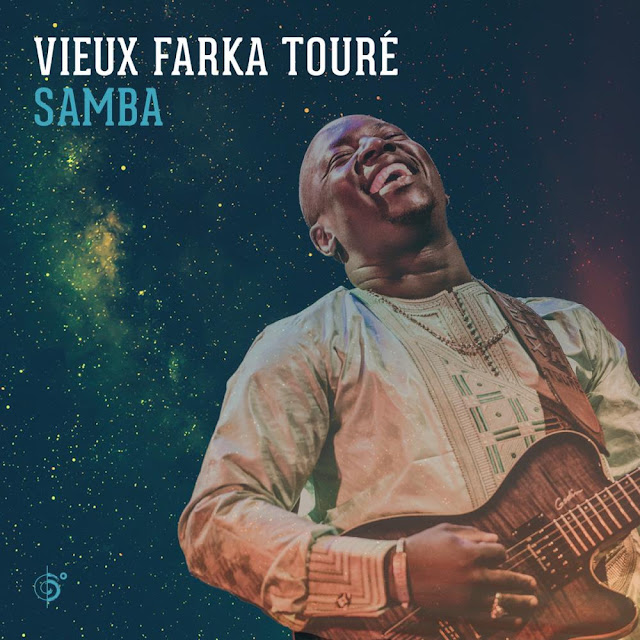
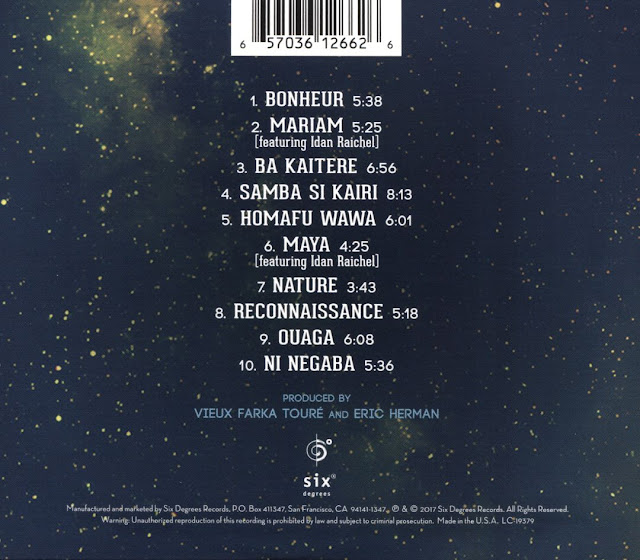
Vieux Farka Touré - Samba - 2017 - Mali


When the producers of Woodstock Sessions, a hybrid / live recording series in Saugerties, NY, asked Malian guitarist and vocalist Vieux Farka Touré to stop in 2015, he didn't have enough time to make it happen. Intrigued, he promised to return the following year. Keeping his word, the result of that incredible session is now Touré's new album, Samba.

Samba's ten songs are new. Given Touré's natural musical curiosity, the mix of Malian blues and songs of praise, funk, reggae and rock make this his most mature and rounded effort to date. The live element, where Touré stands out as an interpreter, shines on all tracks, although the band stopped when they wanted to change something. This was not your average performance.

"It was not a regular study session or a concert," Touré says. "I was somewhere in between. We were recording the album, but we had an audience of about fifty people in the room with us. The audience understood that it was to witness the process of recording an album, not to present a concert in a studio, which was very good because we had the energy of a live concert with the quality of a studio recording. It was an interesting idea, but I didn't know how it was going. Fortunately everything was perfect. There was a great atmosphere there for the session and we were able to capture this unique energy for the album. ”

Touré fans will rejoice over the quality and energy of this fantastic album. His solos are exceptional. The hypnotic grooves that his band creates allow him to let go with a sense of ease and grace.

Samba means "second born", his place in his family, which of course went to the legendary Mali artist Ali Farka Touré. While many cultures grant the first position of a family to the firstborn, he is the second child who is often conferred with power in the tradition of Touré. "Samba is one that never breaks, that never runs from threats, that is not afraid," Touré says. "It is said that Samba is blessed with good luck."

In recent months, Touré has traveled through Australia and China to spread its energetic and magnificent evolution of the Malian blues. Now he is returning to where he built his name, with tours in the United States and Europe planned for 2017.