Radio Salone

Travel Through Music

Post Top Ad

septiembre 28, 2022

Youssou N'Dour - Africa Rekk - Senegal - 2016


Some of the most exciting sounds to come out of Africa in the late 1980s and 1990s were produced by Senegalese-born vocalist Youssou N'Dour. Although rooted in the traditional music of his homeland, N'Dour constantly sought new means of expression. In addition to recording as a solo artist, N'Dour collaborated with a long list of influential artists including Paul Simon, Peter Gabriel, Neneh Cherry, and Branford Marsalis. A native of Dakar's impoverished Media section, N'Dour inherited his musical skills from his mother, a griot (oral historian) who taught him to sing as a child. Before his teens, N'Dour joined Dakar's popular Star Band at the age of 19. Within two years, he had assumed leadership of the group, which he renamed Super E'toile de Dakar. With the band accompanying their four- or five-octave vocals, N'Dour helped pioneer mbalax, an uptempo mix of African, Caribbean and pop rhythms. First performing in Europe in 1984, Dakar's N'Dour and Super E'toile made their North American debut the following year. N'Dour's talents soon attracted the support of top musicians. In 1986, his vocals were featured on Paul Simon's Graceland and Peter Gabriel's So. He subsequently traveled the world as an opening act for Gabriel. His biggest exposure came when he agreed to co-star, along with Gabriel, Bruce Springsteen, Sting and Tracy Chapman, in Amnesty International's Human Rights section. He toured in 1988. The same year, he performed at the well-known birthday concert for South African activist (and president) Nelson Mandela at Wembley Stadium in London. N'Dour cemented his reputation in 1989, when he released his first internationally distributed album, The Lion, which featured a tune, "Shaking the Tree," that he co-wrote with Gabriel. After signing with Spike Lee's Columbia label 40 Acres & a Mule, distributed on Columbia, N'Dour earned a Grammy nomination in 1991 with his first effort on the Eyes Open label. He continued to seek new opportunities for his creativity, including an African opera that premiered at the Paris Opera in July 1993. Recorded in Senegal, N'Dour's album The Guide, released in 1994, featured his duet with Swedish vocalist Neneh Cherry, "Seven Seconds". A series of greatest hits packages, reissues, singles and even a few full-lengths - including a handful of Nonesuch, 2002's Nothing's in Vain, 2004's Egypt and 2007's Rokka Mi Rokka, issued in the late '90s and on the next century, with N'Dour working with artists from Etoile de Dakar to Gabriel. Grammy-winning Egypt caused a cultural and political stir when it was released during the month of Ramadan. A documentary DVD focusing on the whole affair, Youssou N'Dour: I Bring What I Love, appeared in early 2010 and included a biography of N'Dour's career, as well as extensive concert footage and a N'Dour film. working on the Egypt project.


01. Gorée 02. Bull Ko Door 03. Be Careful 04. Jeegel Nu 05. Conquer the World (feat. Akon) 06. Exodus 07. Ban La (feat. Fally Ipupa) 08. Oumar Foutiyou Tall 09. Dawal (feat. Spotless) 10. Serin Fallu 11. Food For All 12. Money Money


septiembre 25, 2022

Urban Village - Udondolo - 2021


With their feet in tradition and their eyes on the future, the four Urban Village musicians set out to raise awareness of the culture and history of the South African township of Soweto, the apartheid-designed dormitory town that became home to of people from all over the country, bringing with them their diverse cultural and musical identities. Urban Village embodies this story, and in their latest work Udondolo (Walking Stick) they present us with a question not only of music but of identity, they are inspired by their upbringing in Soweto and build their imaginary based on the quasi-romantic idea of ​​life in rural.

Urban Village was formed in 2013 when bandleader guitarist Lerato Lichaba teamed up with vocalist and flutist Tubatsi Mpho Moloi (who also plays the mbira), drummer Xolani Mtshali, and bassist Simangaliso Dlamini. They were all born in Soweto in the last days of apartheid, and the story of Urban Village is one of chance encounters and shared values.

Lichaba is an alumnus of Bantu Continua Uhuru Consciousness (BCUC), the Soweto avant-garde collective that plays "Afropsychedelic future pop" and sings in all eleven official languages ​​of South Africa. Curious naturally, one day Lichaba came across older Zulu musicians playing maskandi on a street corner in Soweto. Lichaba was inspired to start mixing this old school maskandi and other styles from his hometowns and rural places that he had been exposed to to create something completely new. The laboratory for these experiments would be improvisation sessions in clubs where the spoken word, hip-hop and jazz came together and where Lichaba met Tubatsi.

Sung in English and Zulu and cooked in his home studio, Udondolo is a stew of the best of South African music from the last few decades: kwaito, jazz, amapiano, mbaqanga, pop, maskandi or swing, and the spiritual energy of South African choirs. , cooked slowly, slowly and mixing all its flavors. A fresh and authentic album, in which ideas flow smoothly, leaving room to breathe, but tracing new paths in each of its songs. Furthermore, Udondolo seems to be bathed in a clear, friendly and cheerful light, leaving the aggression of modern beats aside. Cuts such as the initials "Izivunguvungu", "Dindi" and "Ubaba", the friendliness of "Marabi" or "Empty K-Set" or the delicacy of "Ubusuku" and "Umhlaba Wonke" make up a work with hardly any ups and downs, delicious, unclassifiable and surprising.

A journey through all the colors of Soweto, which has become a music laboratory where, even today, the hopes of an entire people resonate.

facebook: Urban Village


tracks list:

01. Izivunguvungu

02. Dindi

03. Ubaba

04. Ubusuku

05. Madume

06. Sakhisizwe

07. Marabi

08. Umuthi

09. Inkani

10. Makolo Yanga

11. Empty K-Set

12. Umhlaba Wonke ft. Msaki


Fuente: http://lauvaylaparra.blogspot.com/2022/07/urban-village-udondolo-2021.html

septiembre 23, 2022

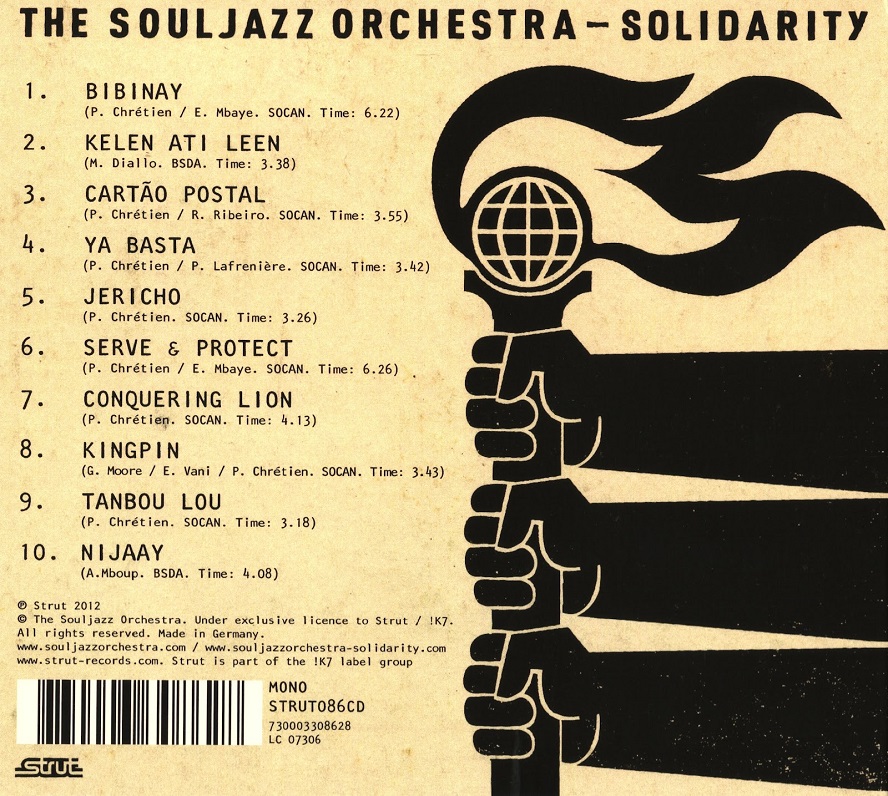
The Souljazz Orchestra - Solidarity - 2012


The Souljazz Orchestra is a Canadian multicultural group, created in Ottawa, that has spent more than a decade perfecting its characteristic sound: a percussion explosion of soul, jazz, Afro, Latin and Caribbean rhythms, backed by an arsenal of analog-style keyboards from the 60s and 70s of the 20th century.

Solidarity (2012) is his latest work (after his wonderful Rising Sun of 2010) made by the British label Strut Records. It features a unique range of artists connected to the group through Canada's vibrant underground scene, coming from a variety of backgrounds, from Senegal to Brazil and Jamaica, catalyzing artistic exchange and allowing the group to remain rooted in musical traditions throughout. while pushing the boundaries of soul, jazz, reggae, tropical and afrobeat styles (reinterpreting each genre as never heard before) unified by an underlying message of social change and interculturality.

Some exciting rhythms, unclassifiable, with the rare ability to skip all the clichés of musical fusion.


Staff:


Zakari Frantz (Alto Sax, Percussion, Vocals)

Ray Murray (Baritone Sax, Percussion, Vocals)

Steve Patterson (Tenor Sax, Percussion, Vocals)

Pierre Chrétien (Keyboards, Percussion, Vocals)

Philippe Lafrenière (Drums, Percussion, Vocals)

Marielle Rivard (Percussion, Vocals)


01. Bibinay (feat. El Hadji "Élage" M'Baye)

02. Kelen Ati Leen

03. Cartão Postal (feat. Rômmel Teixeira Ribeiro)

04. Ya Basta

05. Jericho

06. Serve & Protect (feat. El Hadji "Élage" M'Baye)

07. Conquering Lion

08. Kingpin

09. Tanbou Lou

10. Nijaay


septiembre 22, 2022

Sibusile Xaba - Open Letter to Adoniah


A key player in the new generation of South African jazz musicians, KwaZulu-Natal-born guitarist and vocalist Sibusile Xaba has all the makings of a master acoustic guitar player. With a vocal style that is part dreamcaping and part ancient invocation, Xaba divines rather than simply sings. Combined with a guitar style that is rooted in expressive choice, Xaba's music breaks the boundaries of the genre, taking only the fundamentals of mentors like Madala Kunene and Dr. Philip Tabane and imbuing them with an improvisational mythology and intensity of their own.


'Open Letter to Adoniah' is a reverent album of life and its connection to a higher source. The music emanates from the dreams revealed to Xaba on consecutive days and most of the album was recorded live in the Magaliesberg mountains outside of Johannesburg in the winter of 2016.


Featuring percussionists Thabang Tabane and Dennis Moanganei Magagula, the trio blends geographical and spiritual influences, hinting at Maskandi (a style of music dominant in Xaba's native KwaZulu-Natal) and the improvisational culture of South Africa's jazz avant-garde. Collectively, the musicians reshape these influences, situating them within rhythms that span the African continent. Thabang Tabane's influence on the project gives it a spiritual sensibility allusive to Malombo's music that his father, the legendary Dr. Philip Tabane, originated in the early 1960s.


1. Open Letter to Adoniah 05:00

2. Wampona 05:29

3. Emazulwini 05:18

4. Sibongile : Tribute to the Mother (Reprise) 04:46

5. Nomaphupho 04:52

6. Angisenalutho 03:52

7. Nyandi Yeni (Interlude) 01:14

8. Swaziland 03:34

9. Liyabukwa 03:57

10. Inkululeko (Reprise) 07:38


Fuente: https://sibusilexaba.bandcamp.com/album/open-letter-to-adoniah


septiembre 18, 2022

Orchestre National de Barbès - Rendez - vous Barbès - 2010


The Orchester National de Barbès is the noise, the smell and the soul of this mestizo neighborhood of Paris, but also the fusion of the different North African and French musical communities, the union of 11 musicians from different regions of the Maghreb and France who set up a repertoire that puts everyone in agreement, Moroccans, Algerians, Tunisians and French from the popular neighborhoods. Their penultimate album, Rendez-vous Barbès (2010), is a synthesis of the 3 previous ones and comes to breathe a new dynamic into North African music of which they are the best ambassadors.


With Algerian and Moroccan roots, the members of this orchestra lived in the Parisian neighborhood of Barbès when they got together to make music in 1995. Barbès is an emblem of the history of immigration in France, the place where many Algerian, Moroccan and , Malians or Senegalese chose their first address, usually a room in a dilapidated hotel, hoping to scrape together a little money. And it is in the cafes of this neighborhood that the North African music scene was born in France, then confidential and frequented only by the hundreds of immigrants who came down to the cafe on their way back from the factory, to listen to some songs from their country. Mythical singers came from there, like Dahmane El Harrachi or Cheb Khaled.


Today, more than fifteen years later, the Orquestre National de Barbès continues to mix traditional Maghrebi styles, raï, reggae and Gnawa music with contemporary sounds and rhythms to show the world the sound richness of Africa, including both the north and the lands. that start from the Sahara desert, emphasizing the most festive rhythms and taking tradition as a base to adapt it to the sounds of today.


Rendez-vous Barbès is a synthesis of his three previous works. Songs inspired by allaoui, raï, gnawa, chaabi, Berber, reggae rhythms... combined with an energy inspired by rock and ska. A snapshot of the energy and creative spirit that characterizes the popular neighborhoods of Paris, an album that invites you to dance and that would almost make you forget the "too serious" of the inhabitants of the French capital. In short, "an intense album, which results in an invitation to travel through that immense world that is found in the streets of that multicultural neighborhood that is Barbès".


Tracks list:

01. Sidi Yahia-bnet Paris

02. Chkoun?

03. No no no

04. Chorfa

05. RDV Barbès

06. Jarahtini-Marhba-Jibouhali

07. Rod Balek

08. Laafou

09. Denya

10. Allah idaouia


Página web oficial: Orchestre National de Barbès

septiembre 13, 2022

Michael Spiro & Mark Lamson - Bata Ketu


In the ebb and flow of life, things come together and things fall apart. This constant rhythm is observed in everyday life, as well as in historical summaries of past centuries. Bata Ketu is an Inter-musical game consisting of six acts. It tells the story of Yoruba music, uprooted from Mother Africa, transplanted in Cuba and Brazil, evolving separately in time, to later come together in the present day. In this meeting of two long separated "brothers", the differences and similarities to create a new form, dynamic art through performance and celebration.


During the long years of slavery in which the Yorubas and their descendants suffered in Cuba and Brazil, their ancestral deities, the Orishas, ​​would appear in the physical world through the possession of the initiates. Through a living art of song, drumming and dance, the orishas have lived as far as the shores of Africa. It could be said that whenever the rhythms of the orisha are played or their songs sung, they exist in our physical world.

Listening to this recording, you will hear the Afro-Cuban and Afro-Brazilian percussion instruments that accompany the call and response to the songs dedicated to the orishas. These spiritual songs invoke beauty and power that communicate directly to the inner being of each person. The songs come from both Cubans (lucumí) and Brazilians (candombe). In some cases, Cuban drums accompany Brazilian songs, while Brazilian drums and rhythms accompany Cuban songs. In other cases, two versions of the same song, one from each country, are sung back to back.


Although both versions are clearly the same song, the difference between the Brazilian and Cuban flavors delights the senses. On the other hand, there is a wonderful sense of balance in Bata Ketu, as Cuban songs are sung by a woman, and Brazilian songs are sung by a man. These arrangements not only demonstrate a deep understanding of both lineages, but also the variety and ingenuity of the groupings in creating new and original musical textures that can be appreciated by beginner and aficionado alike.


The extraordinary music heard at Bata Ketu is the work of two visionary American percussionists, Michael Spiro and Mark Lamson. They are accompanied by Brazilian Percussion Master Jorge Alabe, Cuban singer and musicologist Bobi Céspedes, and Regino Jiménez considered one of the greatest olú -batá (percussionist) from Cuba.

Fuente: http://www.bembe.com/bataketu/

agosto 31, 2022

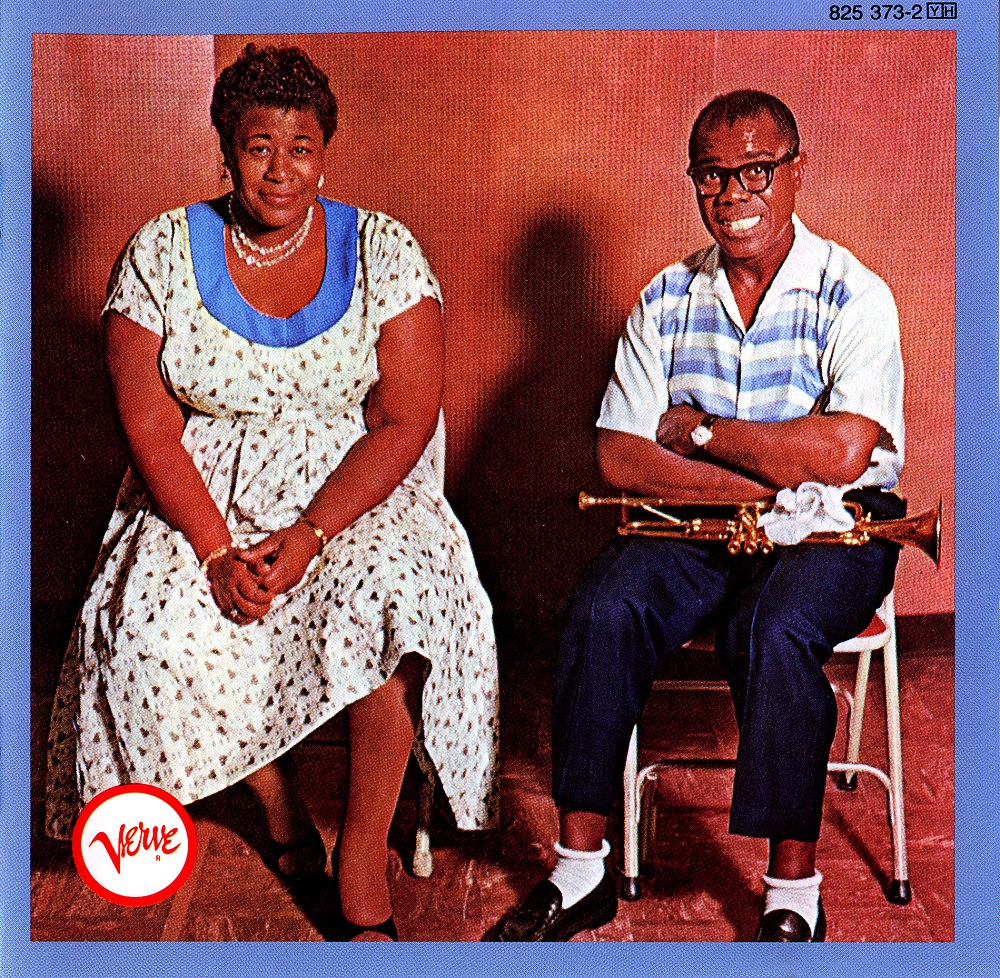
Ella Fitzgerald y Louis Armstrong - Ella & Louis - 1957


Ella & Louis, the magic, Ella Fitzgerald and Louis Armstrong, two angels who, apart from Porgy and Bess (Gershwin's opera), only recorded two more albums. The sweetest music ever recorded, it is not possible to listen to Ella & Louis without smiling. It's like an unavoidable partnership that makes you wonder what titanic forces of nature kept Ella and Satchmo apart until they made this record together in 1957, backed by the trio of Oscar Peterson and Buddy Rich on drums.

She and Louis have been the most amazing jazz couple ever. Each one in their plot gave lectures and defined styles, becoming absolute references. Duke Ellington, Cole Porter, Bing Crosby or Frank Sinatra, for example, refined their styles from Ella and Louis.

Ella Fitzgerald, a New Yorker who disappeared in 1996, is considered among the most important jazz singers in history. In addition, she shone in all the styles that she had to interpret (be-bop, blues, soul, swing...). And her résumé includes performances with Count Basie, Duke Ellington, Oscar Peterson, Dizzy Gillespie, Joe Pass, and (of course) Louis Armstrong.


For her part, Louis Armstrong, from New Orleans, who died in 1971, "Satchmo", was the most popular jazz musician, trumpeter and singer in US history. Protagonist of an incredible personal story, in his childhood he was abandoned, he grew up in a reform school, he played a “cornet” for pennies… And he demonstrated his political and civil rights commitment with actions, financially supporting Martin Luther King, confronting Eisenhower, and fighting for the rights of African American citizenship in the South. Louis Armstrong is one of the most charismatic and innovative figures in the history of jazz. Thanks to his musical skills and his brilliant personality, he transformed jazz from its initial status as dance music with folk roots into a popular art form. Although at the beginning of his career he cemented his fame above all as a trumpeter, later on it would be his condition as a vocalist that would consecrate him as an internationally recognized figure with enormous influence on jazz singing.

So Ella and Louis getting together is magical. One of the best with one of the best. The songs they perform together are standards, extraordinary standards, of course, like "Moonlight in Vermont," "A Foggy Day," and "Stars Fell on Alabama." But nirvana is "Cheek to Cheek", "The nearness of you" and "April in Paris". You touch the sky with your fingers.


Tracks list:

01. Can´t we be friends

02. Isn´t this a lovely day

03. Moonlight In Vermont

04. They can´t take that away from me

05. Under a blanket of blue

06. Tenderly

07. A foggy day

08. Stars fell on Alabama

09. Cheek to Cheek

10. The nearness of you

11. April in Paris


agosto 25, 2022

Bombino - Azel - 2016 - Niger


"I finally ran into Bombino last fall, walking into the sprawling barn studio in upstate New York where we'd like to record Bombino's third studio album, Azel. There she was, relaxing on the couch, chatting in Tamasheq with his bandmates behind a barely perceptible smile.wearing a blue bubu, the traditional Tuareg formal dress, and nodding along as he played from the studio's stately Genelecs.Although he speaks Tamasheq, Arabic, and French, he rarely Instead he speaks at all. Instead, he plays the guitar."


In an interview with Rolling Stone magazine, Bombino comments on what it's like working with Longstreth compared to his experience working with the Black Keys' Dan Auerbach (who produced Nomad):

I would say it was more relaxed than working with Dan. Dan had a clear idea of ​​what he wanted right away and would lead us this way and that way until he had registered what he already had in his head. With Dave who was very happy to be patient, and listen to what we were playing, not push one way or the other, and then slowly, over days, he would start to shape things the way he wanted. I was very happy with the way Dave worked, because working with Tuareg music and musicians can be very complicated. We are not like American musicians in many ways. Our skills and knowledge are very different from western musicians. And of course our language and culture is also very different. So this can be quite a challenge, but Dave handled it very gracefully. He would hang out with us, have dinner with us and joke around. We've had a lot of fun together. Actually, it was a beautiful time.


The word "Azel" has three meanings in the native Bombino Tamasheq language-first, it is the name of a small desert town a few kilometers from where he grew up, in Agadez, Niger. His wife's family is from Azel, and it is the site of the first and only Tuareg school in the country. Bombino has long held aspirations to develop a Tuareg arts school and community center in Agadez, and the city of Asel holds a special place in his heart. Second, the word azel means the roots or stems of a tree. This album is a reflection of Bombino's unique place in Tuareg music in that he simultaneously honors the traditional roots of the music while still taking on entirely new territory, thus roots and stems. Lastly, the word azel is also Tamasheq slang, loosely equivalent to 'it's my chance!' In American English. The importance of that meaning should be immediately obvious to anyone who listens to this album.


01 Akhar Zaman (This Moment)

02 Iwaranagh (We Must)

03 Inar (If You Know The Degree Of My Love For You)

04 Tamiditine Tarhanam (My Love, I Tell You)

05 Timtar (Memories)

06 Iyat Ninhay / Jaguar (A Great Desert I Saw)

07 Igmayagh Dum (My Lover)

08 Ashuhada (Martyrs Of The First Rebellion)

09 Timidiwa (Friendship)

10 Naqqim Dagh Timshar (We Are Left In This Abandoned Place) 


agosto 18, 2022

Youssou N´Dour - Rokku Mi Rokka - 2007


Rokku Mi Rokka (give and take) was the next studio album by Senegalese singer and songwriter Youssou N'Dour, after winning the Grammy, in 2005, for the album Egypt. The album, sung in Wolof (the majority language of Senegal), contains eleven new songs and five bonus tracks, with a vibrant African rhythmic pulse. The inspiration for the album comes from the sounds of the areas of Senegal that border Mali and Mauritania. In it you can also hear, in the words of the singer himself, "some reggae, blues and a bit of Cuba. In Africa we get excited when we hear these sounds because they are part of our cultural heritage."


Youssou has recorded the album with his touring band Le Super Etoile de Dakar, featuring Neneh Cherry, Malian musician Bassekou Kouyate and members of the Orchestra Baobab.


Tracks list:

01. 4-4-44

02. Pullo Àrdo (Le berger)

03. Sama Gàmmu (Mon rival)

04. Bàjjan

05. Baay Faal

06. Sportif

07. Tukki (Voyage)

08. Létt Ma (Irrésolution)

09. Dabbaax

10. Xel (Intelligence)

11. Wake Up (It's Africa Calling) (con Neneh Cherry)


Bonus tracks:

01. Boul Bayékou

02. Beugue Dou Bagne

03. Borom Gaal

04. Téléphone

05. Yonou Deugue


agosto 11, 2022

Scientist Meets The Roots Radics - Scientist Meets The Roots Radics - 1981 - Jamaica


Scientist Meets The Roots Radics - Scientist Meets The Roots Radics - 1981 - Jamaica


Brown (Scientist) was introduced to electronics by his father, who worked as a television and radio repair technician. He began building his own amplifiers and would buy transformers from Tubby's Dromilly Road studio, and while there would keep asking Tubby to give him a chance at mixing. He was taken on at Tubby's as an assistant, performing tasks such as winding transformer coils, and began working as a mixer in the mid-1970s, initially creating dubs of reworked Studio One riddims for Don Mais' Roots Tradition label, given his chance when Prince Jammy cut short a mixing session for Mais because he was too tired to continue. The first hit record that he mixed wasBarrington Levy's "Collie Weed".

He left King Tubby's studio at the end of the 1970s and became the principal engineer for Channel One Studio when hired by the Hoo Kim brothers, giving him the chance to work on a 16-track mixing desk rather than the four tracks at Tubby's.


He came to prominence in the early 1980s and produced many albums, his mixes featuring on many releases in the first part of the decade. In particular, he was the favourite engineer of Henry "Junjo" Lawes, for whom he mixed several albums featuring the Roots Radics, many based on tracks by Barrington Levy. He also did a lot of work for Linval Thompson and Jah Thomas. In 1982 he left Channel One to work at Tuff Gong studio as second engineer to Errol Brown. He then emigrated to the Washington, D.C. area in 1985, again to work in studios as a sound engineer.


Jah Army

Flabba Is Wild

Some Dub

Whip Them

Fighting Radics

Kill The Devils Wife

Jah Is Love

Wa Di Is Free

Best Dub On Yah

Forward Dis Ya Dub

Weep And Wail *

Gunman *

Radification *

Inforce Ah *

Road Block *


Producer : Errol Flabba Holt


Mixing Engineer : Scientist

Engineer : Bunny Tom Tom


Backing Band : The Roots Radics

Drums : Style Scott

Bass : Errol Flabba Holt

Lead Guitar : Noel Bailey & Dwight Pickney

Rhythm Guitar : Bingy Bunny

Keyboards : Steely

Piano : Gladstone Anderson

Trombone : Nambo Robinson

Saxophone : Dean Fraser

Percussions : Sky Juice


Studios :

Recording : Channel One (Kingston, JA)

Mixing : King Tubby's (Kingston, JA)


 (Fuente: Wikipedia)

agosto 06, 2022

Orishas - A lo cubano - 1999


The Cuban group Orishas mixes hip hop rhythms with traditional sounds from the Caribbean island. The three members of Orishas met in Paris and live throughout Europe (Roldán in Paris, Ruzzo in Milan and Yotuel in Madrid). Roldán González Rivero has been singing since he was 8 or 9 years old, he studied classical guitar and choral singing at the conservatory and has worked with several Cuban traditional music groups. In 1997 Roldán had the singing voice in the group Rico Son and Ruzzo (Hiram Riverí Medina) and Youtel "Guerrero" (Yotuel Omar Romero Manzanares) rapped together with Joel "El Pionero" Pando in "Amenaza", one of the pioneering bands of the Cuban hip hop scene.

After winning the Grand Prix with "Amenaza" at the 3rd Edition of the semi-clandestine Cuban Rap Festival, Ruzzo and Youtel wanted to do something else, but the group could not decide, so Ruzzo and Yotuel were joined by Liván, with extensive experience in the Franco-Cuban musical world. To complete the formation, guitarist Roldán joined them.

For a long year they were working in Paris, with the collaboration of rap producer Niko Noki. The result was an album entitled A lo Cubano, published in 1999, with excellent reviews in the press throughout Europe since it went on sale. This album became a gold record in France and Switzerland and was the first hip hop album to be certified platinum in Spain, exceeding 100,000 copies sold.

After some personal problems, Liván leaves the group in the middle of a tour of France. Shortly after, Orishas went on a triumphant tour of Cuba, where his success was tremendous.


Tracks list:

01. Intro

02. Represent (feat Niko Noki)

03. Atrevido

04. A Lo Cubano

05. Barrio

06. S.O.L.A.R.

07. 1.9.9.9.

08. Atención

09. Mística

10. Canto Para Elewa y Changó

11. Madre

12. Orishas Llegó (feat Niko Noki)

13. 537 C.U.B.A.

14. Connexión

15. Triunfo


julio 30, 2022

Judy Mowatt - Only A Woman - 1982 - Jamaica


Judy Mowatt is a renowned reggae singer. Mowatt's musical career began with the revival of The Gaylettes, a group that ended up becoming one of the island's benchmarks at the end of the 1960s. From this first stage, the songs Silent River Runs Deep, the band's first national success, Take a Chance On Me and numerous coppers by American soul and R&B bands such as Stevie Wonder, Dusty Springfield or Young Rascals, should be highlighted. The sudden departure of the other two members of The Gaylettes, Beryl Lawson and Merle Clemenson, left Judy in the lurch, while totally free to start, although not for long, her solo career. At this time she records numerous covers of American groups and two new hits under the pseudonym Julianne: In Paradise and The Gardener.


Two years later, in 1974, Judy teamed up with Rita Marley and Marcia Griffiths to form the I-Threes. The group reaps very good reviews and Marley, who was looking for a replacement in the choirs of The Wailers after the departure of Peter Tosh and Bunny Wailer, adds them to his band to collaborate on his albums.


Her contact with the King of Reggae caused Mowatt to adopt the Rastafari doctrine and join the Twelve Tribes of Israel. As a result of this change, compositions such as Black Woman, Many Are Called and Slave Queen were born, which will form part of her second solo LP: Black Woman.


Highly recommended work by Judy Mowatt. Beautiful high register of voice and some gospel phrasing denote this download of experience and learning by Judy.


Tracks


You're My People

Only A Woman

Trade Winds

Think

Got To Leave The West

I Am Not Mechanical

On Your Mark

Big Woman

You Dont Care

King Of Kings 


julio 27, 2022

FATOUMATA DIAWARA - ROBERTO FONSECA - AT HOME - LIVE IN MARCIAC - 2015 - MALÍ - CUBA


Transatlantic meeting between Malian singer Fatoumata Diawara and Cuban pianist Roberto Fonseca.


The Cuban pianist and the Malian singer have a lot in common: their youth, enthusiasm, generosity and a beautiful route through the exploration of their roots, while projecting themselves towards other cultures. At the beginning of your adventure you will continue on the great stages of the world, these selected pieces are a beautiful symbol; Beyond a musical encounter that sweeps across geographical and musical continents, one feels the most beautiful messages: one of tolerance and peace.


1. Sowa 6:54 

2. Connection 14:01 

3. Yemaya 6:08 

4. Real Family 6:38 

5. Clandestin 7:41 

6. Neboufo 6:36


julio 21, 2022

Bombino - Agadez - 2011


The music of the Tuareg guitarist Omara "Bombino" Moctar perfectly represents his hometown, Agadez (Niger): located in the middle of the great Sahara desert, it was for centuries a meeting point for nomadic camel caravans. And so is Bombino's music, a meeting of sounds where his influences are cited, from Tinariwen and Ali Farka Touré to Jimi Hendrix and Jimmy Page.


Much of Bombino's music was born in response to the violent repression perpetrated by Nigerian government forces against the Tuareg to quell the pro-independence revolts they staged. In fact, Bombino had to go into exile for many years to escape repression. His compositions emerge from that experience and his overcoming: the powerful notes that spring from his electric guitar capture the spirit of resistance and rebellion, and recall others like Tinariwen or Ali Farka Touré.

Tribute album to his hometown, Agadez (2011), edited by Cumbancha, has been recorded in two very different locations. One was in a studio in the United States and the other includes part of a live performance in the city that gives the album its title. The songs appear mixed on the disc and it is not specified which is recorded in the comfort of a studio or in the Saharan desert, but it is enough to listen to the songs to quickly realize where each one comes from. The songs recorded in the USA show a shy and restrained Bombino, while the ones recorded live give off an electrifying energy. There are "Tar Hani", "Kammou Taliat" or "Iyat Idounia Ayasahen".


Very high level repetitive music that catches you from the beginning, in Agadez you can hear some of the most captivating riffs of today. Absolutely magical.


Tracks list:

01. Ahoulaguine Akaline (I Greet My Country)

02. Tar Hani (My Love)

03. Adounia (Life)

04. Kammou Taliat (You, My Beloved)

05. Tigrawahi Tikma (Bring Us Together)

06. Tenere (The Desert, My Home)

07. Iyat Idounia Ayasahen (Another Life)

08. Azamane (My Brothers United)

09. Assalam Felawan (Peace To You)

10. Tebsakh Dalet (A Green Acacia)


julio 21, 2022

Ayub Ogada - Kodhi - 2015


Ayub Ogada is one of Kenya's finest musicians, an intimate singer and exponent of the nyatiti lyre who has enjoyed an extraordinary career. In the 1980s he was busking on the London Underground. He subsequently caught the attention of Peter Gabriel's Real World, recorded the (considered a classic) album En Mana Kuoyo in 1993, and opened for Gabriel on his European tour.


He now resides back in Kenya, where he recorded this new album Kodhi (2015) with producer and guitarist Trevor Warren who, in 2012, moved in with a mobile crew to do the recording. Ogada likes to perform outdoors, and is accompanied by a small group who add guitars, bass and percussion (Dudley Phillips and Hossam Ramzy), along with the ambient sounds that are picked up on the recordings. A set that results in an exquisite relaxation with sections that sound like a happy rehearsal or a jam session, where his gently hypnotic voice stands out along with the solo riffs of his beloved lyre. A long-awaited effort that possesses the same transparent simplicity that made their previous record a staple of world music compilations since 1993.


01. Dero

02. I Para Ango Yawa

03. Kodhi

04. Otenga

05. Waritarita

06. Harmonic

07. Conversation

08. Funeral

09. Extreme

10. Traditional

11. A Prayer